









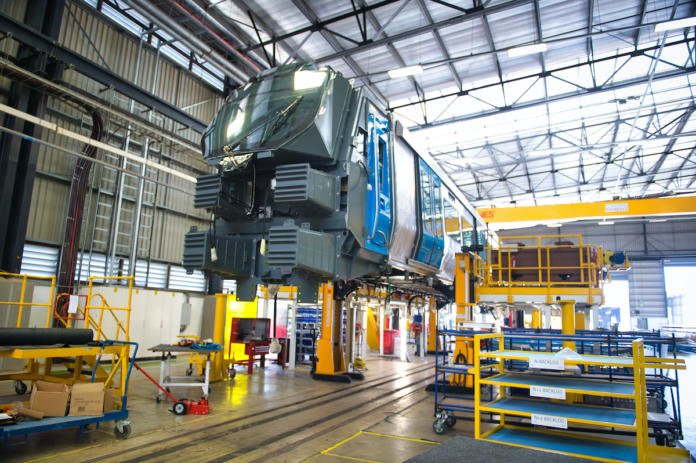
TRAIN-maker Gibela’s attention to research and innovation is helping the Tshwane University of Technology (TUT) ensure students also develop practical entrepreneurial skills.
Engineering students at the university have registered a company that has already provided 46 jigs to Gibela. Jigs are manual or automated tools that hold in place a part that needs further work done on it and also control the motion of a separate tool that is used to do the work.
One of Gibela’s primary aims is to help South Africa meet its National Development Plan target of eliminating poverty and inequality by 2030, says the company’s Executive for Corporate Services and Traction Motors Operations, Dr Buyiswa Mncono-Liwani.
“We want to see South Africa and South Africans thrive, and we believe that one of the most effective ways to do this is through education,” she says.
“We sponsor education projects from early childhood development to postgraduate, all with the aim of ensuring South Africans gain the skills they need to survive in the 21st-century job market, where people need skills such as literacy, numeracy, problem-solving, communication, self-management and the ability to learn continuously.”
Begun in 2017, the jig production project has seen two patents submitted for registration, and around 30 students employed on the full complement of projects – which include the design and making of the “dedicated jigs”, which are custom-designed for one part, another to design and make a set of “reconfigurable jigs” , which are adjustably-design for part variety. Other projects include the virtual reality rendering of jigs for virtual assembly skills development, and various initiatives to ensure locally developed technology that can be applied in train-making and adapted to associated transport manufacturing sectors of the local and global economy.
Instead of giving this work to an established engineering company, Gibela chose to give it to TUT.
“They took a risk in the interests of developing students’ technology skills and entrepreneurial capabilities,” says the DESI NRF SARChI Future Transport Manufacturing Technologies, Industrial engineering Professor Khumbulani Mpofu at TUT.
TUT and Gibela have established RMCERI, a technology business incubator, partly-funded by the Department of Small Business Development, that helps the students with the business side of their newly fledged enterprise. The incubator has a dedicated modern infrastructure, Centre Manager and a Technology Officer.
Prof. Mpofu says the making of the jigs can be either manual or automated, this means that the entrepreneurs are 4IR competent and ready to exploit robots and future technologies. This creates more jobs in robot programming, advanced manufacturing, additive manufacturing, and logistics, driven by improved SA quality of products and opening of global manufacturing supply chains.