










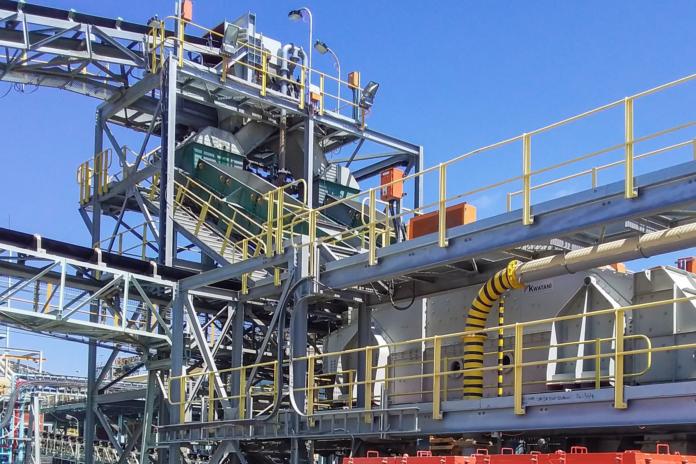
A revolutionary new concept in fines scrubbing has been installed by Ekapa Minerals at its Combined Treatment Plant (CTP) in Kimberley processing both virgin underground kimberlite as well as tailings for retreatment , and it is proving itself as a game-changer.
The innovation, developed by Multotec Wear Linings, is a pulping chute that scrubs and washes the recrushed product after it has passed through the High Pressure Grinding Rolls (HPGR) interparticle tertiary crushing circuit. The important advantage here, according to Multotec Wear Linings projects sales manager John Britton, is that it performs the scrubbing action faster and more efficiently than a traditional rotary scrubber would, and at much lower cost.
Multotec commissioned two of these pulping chutes at Ekapa Minerals in late-2019, where they have been operating consistently and in line with expectations. With the use of patented wave generators, the pulping chute uses the gravitational energy from the slurry flow to create a constant turbulent mixing action that releases the mud, clay and slime sticking to the kimberlite particles.
According to KEM CEO Jahn Hohne, the pulping chutes are a welcome contribution to the company’s cost saving efforts, and a clear demonstration of Multotec’s expertise in developing value-adding solutions in the mining sector.
“The dual chute pulping plant is ideally suited to de-conglomerating the HPGR cake product and is exceeding expectations in efficiency and effectiveness at over 600 tph, which is a major relief on the existing overloaded pair of CTP scrubbers. The net result is a meaningful increase of up to 20% throughput capacity of the entire processing plant which substantially improves the economy of scale of CTP, feeding directly to the bottom line,” he says.
Britton highlights the efficiency of the system, which is able to aggressively scrub the material in just three to four seconds as it passes through the chute. This represents just a fraction of the usual retention time in a rotary scrubber, which is three to four minutes. He also emphasises the drastic reduction in running cost which the pulping chute achieves.
“From our experience of plant layouts and flow diagrams, it is clear that fines scrubbers are significant contributors to a plant’s capital, operating and maintenance costs,” he says. “Scrubbers are equipped with large drives with gears and gearboxes to rotate the drum. They are high consumers of power and require mechanical component maintenance which means higher operating costs.”
Substantial structures and supports are also needed for the scrubber and its drive mechanisms. In designing the pulping chute, Multotec sought a simplified solution, he says. In addition to improving scrubbing efficiency, the objective included reducing the cost of replacing scrubber liners and the downtime that this demanded. The cost of replacing the steel shell of a scrubber – which was constantly subject to stress, wear and fatigue – was another cost to be considered.
The pulping chute, by contrast, is a stationery and much simplified innovation, focused on the scrubbing of fines less than 32 mm in size. Slurry deflectors located at the top end of the scrubbing chute direct at least part of the slurry away from the scrubbing chute floor. This curls into an arched form which flows backwards into the approaching flow of slurry, creating the turbulent scrubbing effect.
“We custom-design the chutes to suit the application and can increase chute capacity to up to 800 tons per hour,” says Britton. “This is achieved with no moving parts, bearings, hydraulic packs or girth gears; the only power required is to supply material and water to the receiving chute. These actions are also required to feed the scrubber, then gravity takes over and provides the required energy”
Maintenance is also streamlined by designing the chute in segments. Should one segment be wearing more than others, it can be quickly removed and replaced – putting the chute back into operation while the original segment is refurbished as a spare.
Britton notes that the pulping chute has drawn interest from other diamond producers in southern Africa, Australia and Canada. It can also be applied in commodity sectors such as coal, platinum, chrome, iron ore and mineral sands.