










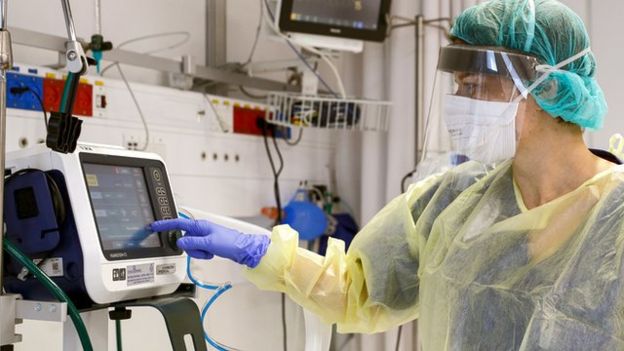
As countries across the globe scramble to source much-needed ventilators to treat COVID-19 patients, government is ramping up the production of the critical equipment.
With more industries set to begin operations when the country moves to level 3 on Monday, Economic Development Minister Ebrahim Patel says this has put a spotlight on what government can do to contain the spread of the virus.
However, Patel has found comfort in “exceptional” groups of South Africans who have rolled up their sleeves to help the country to deal with the peak of infections by manufacturing local products such as masks, sanitisers and ventilators.
“What happens if the virus in spite of hand sanitisation and masks or perhaps instances where these aren’t fully adhered to; when the virus enters the body,” he asked.
“It means that people will need to get some attention and many South Africans as Dr Zweli Mkhize said will have mild symptoms, but there are those who will have challenges and will need to be rushed to hospital.”
Therefore, it is for this reason they are speeding up production of ventilators, he said.
“Ventilators are a way of getting oxygen to the lungs at a time someone is infected by Coronavirus and have difficulty breathing,” he explained.
In April, government launched a National Ventilator Project aimed at building more local machines since there is a shortage of ventilators from the rest of the world.
“But everybody was chasing the same product, so wherever the factories were making these products elsewhere, the others were immediately snapped up and we couldn’t get enough ventilators into South Africa.”
The country last produced ventilators almost two decades ago, he said.
“When the pandemic hit us, we had no local manufacturing capability.”
After making the public call for innovators to come up with ideas, the project came to life. The country has now produced prototype ventilators.
“We’re now working on getting three prototypes finalised and after that, production will start in June and the first units we hope will come off the production line during June.”
Government is hoping to produce a targeted 20 000 ventilators by August.
“This will be critical additional stock… while we’re also trying to find ventilators from the rest of the world.”
SA needs more masks as people return to work
As eight million are expected to go back to work from Monday, Patel said South Africa would need more masks.
“Face masks are critical for healthcare workers over the period as the economy opens and the level of infection rises and more people will need attention in hospitals,” he said, adding that this puts more pressure on the staff.
Required masks range from surgical N95, FFP2 and FFP3 masks.
“I think the important story today is how we’ve been able to use local manufacturing to make these advanced masks.”
Since the start of the pandemic, there has been a scarcity, but over recent weeks, entrepreneurs, government agencies, and others have been working tirelessly to produce these.
“In this month of May, we were able to produce about 25 million of these surgical and medical masks.”
By the end of June, they are projecting to produce about 31 million masks.
“This means a million masks every single day, Mondays to Sundays that are running off the production line,” he said.
Some companies produce face shields, medical scrubs, disposable overalls, isolation gowns and industrial alcohol for hand sanitisers.
COVID-19 Black Business Fund
In addition, the National Empowerment Fund has put aside R80 million for the COVID-19 Black Business Fund.
“They’ve been overwhelmed by applications, more than 300 have been received, well more than the money that is set aside.”
They have also granted repayment holidays to about half of the businesses they support.
The department is continuing with its efforts to challenge price hikes.
“Some prices may be unavoidable because we import the products and as the rand value drops the cost of these products increase,” he explained.
“Our laws don’t allow excessive prices by dominant players and unjustified exploitation of the market.”