







The offices spaces of today are nothing like the work environments of the past. The quantum leap forward in information technology, office equipment, and management practice has changed the way we work forever.
Light, lean laptops that can be moved at a moment’s notice, virtual meeting rooms where users can join multiple colleagues from around the world in real-time, via live stream, and flexible environments that adapt to changing organisation needs are the norm today. But this has only been the case for the last 15 years.
“If you were to step into an office space from the 1980s or 1990s, it would look very different to the work spaces of today,” says David Seinker, CEO of The Business Exchange. “You would likely have seen formal, separate offices, and desks with heavy, immovable single-purpose devices such as typewriters and desktop computers. Jumping to the next decade, your typical 1990s office environment was a cubicle farm with grey, bulbous computer monitors, which was later found to have a distinct negative impact on employee wellbeing, productivity and creative thinking.”
Recent changes in the capacity and portability of office technology, like ultra-thin notebooks, digital whiteboards and cloud computing have catalysed the work environment and freed up businesses to shed the confines of the traditional, fixed way of working in favour of flexible, adjustable environments conducive to deep work and creative solutions,” he says.
Tech isn’t the only factor driving the evolution of the office. Co-working spaces came to the fore in the early 2000s, offering a workplace solution for independent workers, entrepreneurs and start-ups. This provided mobile workers and freelancers the benefits of operating in a shared space with like-minded people, without being locked down in long-term contracts. As enterprises scale, shared workspace venues have the benefits of offering professional services that help create a good impression, such as reception, and training and meeting rooms, without a business burdened with the full-time running costs of these amenities. This frees up cash flow for more important investments in talent and expansion.
“In our experience, many of the SMEs that begin as start-ups operating out of The Business Exchange, remain as they scale,” adds Seinker. “Management practice styles have changed, with many modern organisations adopting flatter hierarchy structures. This helps remove barriers and promotes communication and collaboration. Our adaptable spaces allow for custom development, while maintaining that creative, start-up energy.”
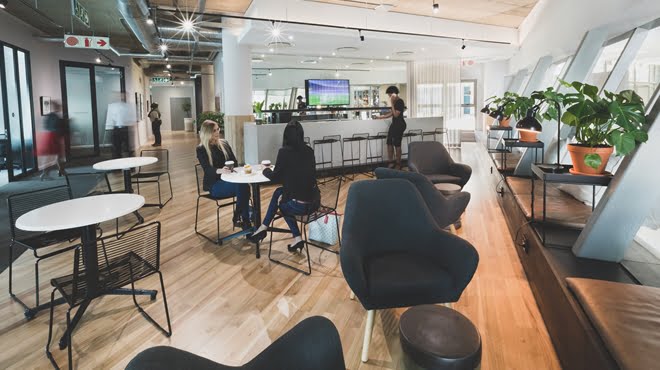
“These days, an office is more than a place to work,” adds Jandre De Beer, of V8 Media, a member of the Business Exchange. “In today’s corporate culture, work surroundings play an important role in attracting and retaining talent. We find that flexible environments which offer pleasant, social surroundings and spaces that allow businesses to nurture employee creativity are the way of doing business in the future.”
Co-working and shared working environments have moved beyond the start-up community and become diverse spaces for businesses to explore and grow. What’s different about today’s offices?
-
“Out with the large fixed desk and in with the hot desk,” says De Beer. “This offers a flexible environment that can be easily expanded as a business changes and grows”. This move also benefits the bottom line as it offers a more efficient, cost-effective use of space.
-
Out with the large open-plan office and in with smaller collaborative hubs. “Separate offices can be isolating, while large open-plan designs have been found to be distracting and make employees feel like they’re on a production line. Smaller collaborative hubs with elements such as breakaway zones allow teams to share a space in an environment that’s conducive to collaboration but significantly less distracting.”
-
Out with no-frills design and in with contemporary surroundings that are easy on the eye. “When it comes to the work environment, looks matter. Attractive, well-designed spaces feel more human, and this has a positive effect on employee wellbeing.”
“On the face of it, these changes to the way we work today may seem cosmetic,” comments de Beer further. “However, the evolution of the office to what it is today has been demonstrated to have a positive effect on businesses. Regardless of the size of a company, organisations note a reduction in absenteeism, increased talent retention and improved business performance. For companies and employees, offices are no longer just a venue you’re in for eight hours a day. They actively contribute to the work experience and offer a new way of doing business.”