










Cape Flats Aquifer Recharge Project on Track as Macpherson Praises Progress
Public Works and Infrastructure Minister Dean Macpherson said the City of Cape Town is on track to complete its aquifer recharge project on time.
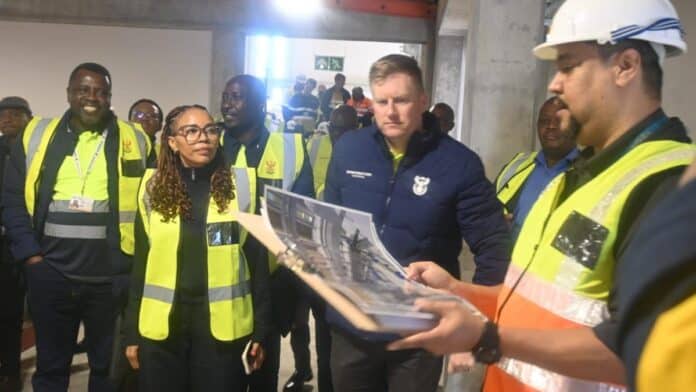
He visited the Cape Flats Aquifer Recharge Project on 23 August with African ministers and mayors.
“It’s groundbreaking what they are doing here and very impressive, and it’s about focusing budgets on infrastructure,” he said during the visit.
He went on to say that the City is weighing an outsourced model, with a private operator maintaining the facility after completion.
Macpherson said he wants other municipalities to replicate the project across South Africa.
The Cape Flats Aquifer Project
The City of Cape Town first commissioned the project in response to the Cape Town water crisis of 2018.
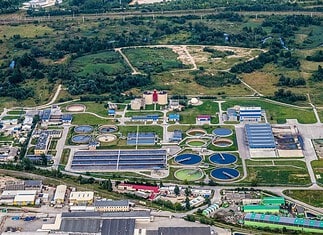
The project centres on the City’s Advanced Water Reclamation Plant, beside the Cape Flats Wastewater Treatment Works in Pelican Park.
The plant treats secondary effluent for injection into the Cape Flats Aquifer, where the water undergoes further natural filtration before groundwater is abstracted and treated to potable standards.
Gravity moves the water through four linear filtration buildings that follow an artificial slope, according to SALT Architects’ Architizer entry.
Injection boreholes will feed the purified water into the Cape Flats Aquifer, where it will filter through sand and rock. The City will draw the water from production boreholes and treat it to SANS 241 drinking water standards at separate plants.
The City’s 2026/27 budget allocates R297 million to the recharge project. The scheme now has 74 completed production boreholes across the Cape Flats.
Other projects include the Table Mountain Group Aquifer, which is the biggest of the three aquifers comprising approximately 11 000 km².
Operator model and the next plants
Macpherson said the City is looking at an outsourced model for the plant.
“What they are looking at is an outsourced model which will then bring an operator to maintain this facility, which is innovative,” he said.
That raises a question that will become increasingly relevant as the City’s alternative-water infrastructure expands: how these assets will be operated over the long term.
David McGibbon, a principal geologist at Umvoto who has worked on the Cape Flats Aquifer Management Scheme, presented the project at the International Symposium on Managed Aquifer Recharge in 2025.
Umvoto says that, because South Africa currently has no legislation governing managed aquifer recharge, international best practices are being adopted to minimise health risks, clogging and water-quality problems.
What it means for Cape Town
The City’s New Water Programme includes groundwater, reuse, desalination and other supply interventions; the City says these are intended to diversify supply and reduce reliance on dams, which remain vulnerable to changing rainfall patterns and drought.
The Cape Flats project is relevant therefore because it illustrates the infrastructure and technical requirements that come with developing alternative sources at municipal scale
Mayoral Committee Member for Water and Sanitation Zahid Badroodien said in April 2025 the plant was on track for full operation by April 2027.
The City’s 19 August update on its 2026 Water Outlook rates the risk of water restrictions higher than in previous years. Water demand rose above the City’s 1.5% target in the 2025/26 financial year, according to the outlook.
The update anticipates first water from two schemes of up to 70 million litres a day, for reuse and desalination, between 2031 and 2036.