








THE outlook for South Africa’s struggling construction industry remains uncertain, hovering between the massive infrastructure expenditure figures being publicly mooted and the State’s seeming inability to implement its economic recovery plans.
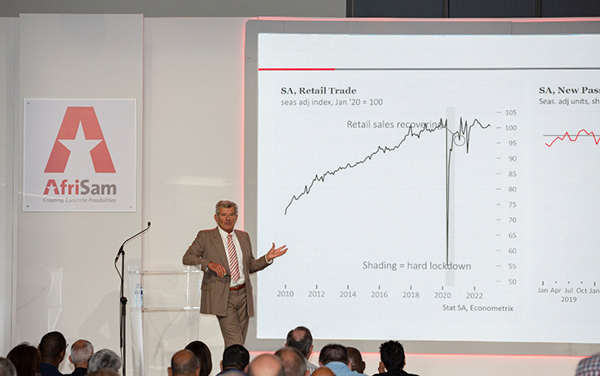
At this year’s AfriSam Budget Breakdown event, now a regular highlight on the construction sector calendar, Econometrix Economist Dr. Azar Jammine pointed to raised expenditure targets for infrastructure. Dr. Jammine said he was encouraged by the growth from R812 billion to R903 billion in the estimates for public sector infrastructure expenditure from the 2023/24 to 2025/26 financial years.
“These numbers are so big that if we were to see their full implementation, it would be a game changer not only for the construction sector, but for the entire economy,” he said. “Where the real hope lies is in government getting its act together and starting to implement its capital projects.”
He noted the importance of how Finance Minister Enoch Godongwana dealt with plans to restructure Eskom’s capital debt, as any worsening of the energy crisis could undermine the economic predictions in the budget speech. If loadshedding was exacerbated, he felt that the country may not even reach its meagre 0,9% growth target for the year. In such a scenario, government’s own spending plans would be further dampened by lower tax revenues.
The question he posed was whether there was the political will within the governing party to allow Eskom’s debt restructuring to take place. Such a move was inevitable, however, as he foresaw a complete realignment of politics in the general elections of 2024.
Focusing on the construction industry, Dr Jammine once again painted a sobering picture – but highlighted the sector’s potential to deliver economic benefits. He reminded his audience that construction provides 7,8% of the country’s employment, even though it makes up just 2,6% of GDP.
“Implementing government’s infrastructure projects would spark massive job creation, and the economy would grow by 5-6% a year,” he said. As it was, business confidence among building contractors continued to deteriorate, although last year this deterioration had slowed.
Commenting on Dr Jammine’s presentation, Richard Tomes, Sales and Marketing Executive at AfriSam said: “Although the operating environment remains challenging, one of the positive elements AfriSam has noted is the increase in the infrastructure spend budget allocation, and we remain hopeful that the implementation of the infrastructure projects will gain momentum and start delivering true value for the construction industry.”
Considerable overcapacity was still evident in the non-residential building sector, especially commercial office and retail space. The value of non-residential building plans passed averaged just about R1 billion in value compared to R3 billion in 2016. The brief recovery in the residential building sector – as homeowners renovated for home offices – had tailed off. Cement demand suffered negative growth in 2022, and was expected to improve only marginally over the next few years, he said.
AfriSam SA Budget Breakdown Event
About this annual event itself, Tomes remarked that AfriSam’s purpose is to make valuable information available to the various stakeholders that interact with its business. “With many of us operating in the same industry, material matters such as the external environment we operate within not only relates to AfriSam but also to our stakeholders’ businesses. We hope that the information being shared at an event like this will not only provide them with insight about some of the decisions that AfriSam takes but will also provide them with valuable insights to enable decision-making in their own businesses or organisations to ensure their future success and sustainability.
For more information visit: www.afrisam.com