








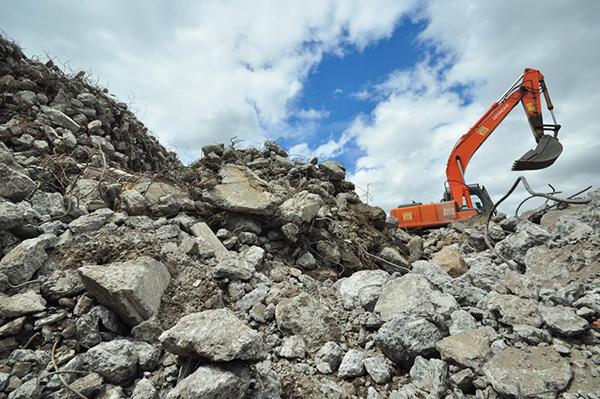
WITH the concrete industry globally determined to become more sustainable, increased consideration is being given to the recycling of concrete, says John Roxburgh, senior lecturer at Cement & Concrete SA’s School of Concrete Technology.
“In terms of sustainability, it is a sound idea to recycle concrete and indeed legislation around the world is enforcing this to an ever-increasing degree. There are many pros and cons to recycling concrete but, if done correctly, it is undoubtedly a winner for the planet. Concrete’s unhydrated cement content can, for a start, be most effectively used when recycling concrete,” Roxburgh explains.
He says it is not generally well-known that in most concretes a significant portion of the Portland cement clinker is never hydrated. “In Portland cement mixes, self-desiccation can occur at water to cement ratios of 0.56 and lower. This is due to insufficient capillary water availability: if no water is fed to the concrete during curing, the capillary water is used up – so no further hydration can occur. In modern curing regimes for larger concrete elements sometimes only surface concrete gets sufficient water during wet curing. If the cement is extended with, say, fly ash or slag, the water to cement ratio at which self-desiccation occurs is lowered.”
Roxburgh says a striking example of this occurrence is a concrete mix design developed jointly by American Engineering Testing Inc. and Cemstone in the USA – a mix that won the coveted American Society of Civil Engineers’ (ASCE) Charles Pankow Award for innovative use of concrete. “Using the unhydrated clinker in the recycled concrete, the design produced a concrete with only 2% Portland cement – that is 46kg of cement in a mix with a plastic density of 2 300kg/m3. With a water to cement ratio of 0.45, this mix achieved an impressive 30MPa compressive strength, post-28 days.”
He adds: “Unique to this mix design was the use of the full grading envelope of the crushed recycled concrete instead of the conventional method of just using the course fraction of the recycled concrete as a substitute for stone. The fine material from the crushed recycled concrete provided unhydrated Portland cement with the cracked-open faces of the fine material, and the fine hydrated cement particles produced a fine filler effect. Increasing the nucleation points for cement gel growth resulted in faster strength gain and the improvement of strength and impermeability of the paste-aggregate interface.”
For further information visit: www.cemcon-sa.org.za