








World too risky for financial deregulation, Reserve Bank Governor warns
By Desmond Thompson (Photo: Ignus Dreyer)
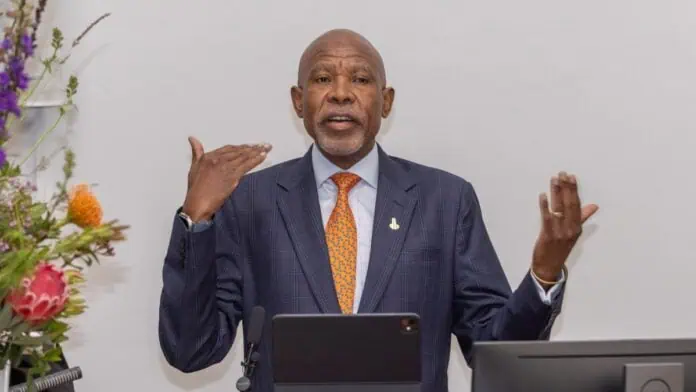
South African Reserve Bank (SARB) Governor Lesetja Kganyago warned last night (25 September) about growing global risks, arguing that the environment calls for “more, not less” financial regulation.
Speaking at the Stellenbosch University (SU), where he serves as Chancellor, Kganyago delivered the Second Annual Financial Regulation Law Public Lecture. He qualified his position, however, by stressing that regulation must be “smart” – proportional and grounded in rigorous analysis and collaboration.
Important dialogue
SU Rector and Vice-Chancellor Prof Deresh Ramjugernath welcomed guests to the Faculty of Law, housed in the Old Main Building. “This lecture series has established itself as an important dialogue at the intersection of law, economics and society,” he said.
He added that Kganyago, who has been SARB Governor since 2014, embodied “the values of leadership, accountability and service that we seek to nurture in our students and scholarship.”
Kganyago received an honorary doctorate from the University in 2018 and was installed as SU Chancellor in June 2025. “It is always a great pleasure to engage with the students and staff of Stellenbosch University,” he replied to Ramjugernath.
Balancing regulation and risk
The topic of Kganyago’s lecture was “More or less regulation: Responding to a changing global environment.”
Setting the scene, he said: “Financial crises are among the most traumatic events a country can experience. Financial regulation is meant to address these problems. The goal is to prevent economic and financial crises by building a system we can all trust. Unfortunately, we do not always agree on how much to regulate.”
He pointed to a regulatory “pendulum”: rules tighten after crises, then institutional memory fades and deregulation follows – often with damaging consequences.
Central to his address was Basel III, the global regulatory framework developed after the 2007–09 Global Financial Crisis (GFC). It requires banks to hold more and better-quality capital – essentially larger financial “cushions” – to absorb losses without threatening depositors or the wider economy.
South Africa adopted Basel III rigorously, Kganyago noted, and while smaller banks faced some costs, the financial system overall absorbed them with minimal impact on growth.
Evolving risk landscape
“I have been involved in financial sector policymaking for close to four decades, both locally and internationally,” Kganyago said. “Over this time, financial stability risks have continuously evolved, and financial regulators have, on far too many occasions, been too slow to identify and respond to them.”
Looking back to the GFC less than 20 years ago, Kganyago observed: “Today, the financial landscape is marked by even higher levels of complexity.”
He warned that “risk factors have increased substantially,” listing threats such as:
- Geopolitical tensions
- Economic fragmentation
- Macroeconomic instability
- Technological advances
- The growth of non-bank financial institutions.
Regarding cryptocurrencies, he flagged speculative growth in the sector: “The sustained growth rates of over 50% in some crypto assets suggest the formation of large asset bubbles.”
Climate change, he added, is another underestimated risk. “Every year projections are overtaken by worse outcomes. Transition risks for South African banks are high.”
On artificial intelligence, he struck a balance, stating: “AI is a double-edged sword: it brings speed and efficiency, but also new vulnerabilities.”
‘Step up, not back’
Kganyago concluded with a firm statement: “The world is living too dangerously for us to be dismantling defences now. We do not need deregulation. Instead, we can regulate more smartly, but the risk environment requires us to step up, not step back.”
Lively debate
In the lively question-and-answer session that followed, those present pressed the Governor on a variety of topics.
One audience member asked whether South Africa risked losing access to US dollars as relations with Washington worsened. Kganyago replied that the dollar continues to dominate global trade and finance.
“Many reserve managers are trying to diversify, but alternatives are limited. This is why geopolitical risk has become one of the most pressing issues we face,” he conceded, noting that even countries with large dollar reserves have found them inaccessible during times of conflict or sanction.
Asked about recent tensions between the Reserve Bank and the Treasury over inflation targeting, Kganyago replied with a metaphor: “We are siblings. There may be rivalry at times, but in the end, we will find each other.”
An audience member remarked: “I just want regulations to be enforced.” Kganyago responded: “Economists always search for the ‘optimal’ level of regulation; lawyers say it must be enforced. Both are right.”
Another question highlighted the role of universities. Responding, Kganyago stressed that regulation demands interdisciplinary expertise: “From law, economics, accounting and actuarial science to computer science – universities play a vital role in equipping regulators with these skills.”
Gys Steyn Chair
In his vote of thanks, Prof Johann Scholtz, the first incumbent of the Gys Steyn Chair, underlined how its mission aligns with Kganyago’s call for smarter, multidisciplinary approaches.
The lecture series honours the late Gys Steyn, a former Chair of the SU Council. Through an endowment by the Steyn family, SU established a Chair named after him in 2023 – the first of its kind in South Africa – to advance teaching, research and debate on the legal frameworks that underpin financial stability.
Since 2024, the Chair has co-hosted a colloquium on green finance and climate risks, taught LLB courses, supervised LLM theses and begun work towards a bespoke LLM in Financial Regulation, the first two modules of which will start next year
Prof Juanita Pienaar, Acting Dean of SU’s Faculty of Law, noted that by hosting the annual lecture and positioning financial regulation as a field of national importance, the Faculty is helping SU affirm its place as a hub for critical dialogue on issues that shape South Africa’s economy and democracy.