








Drought affects Cape Town as ‘Day Zero’ looms large in the public imagination, including for professional services businesses. The first of a two part feature looking at the impact on the legal profession.
Having suffered from drought for over three years, a continuing water resources crisis affecting Cape Town took a new twist this week, with an announcement from the South African government that a state of national disaster was now in effect in Western Cape Province, of which Cape Town is the capital. The announcement will enable ZAR 70 million in central funding to be able to deal with the drought, spread between the Western, Eastern and Northern Cape provincial regions.
The city, and the province, has employed strict water saving measures as a consequence, restricting individual use to 50 litres of water a day – amounting to one short shower, one flush of the toilet, and one load of washing per week, once all other uses are factored in – in an attempt to stave off ‘Day Zero’, the day at which Cape Town’s water supply runs out.
Two weeks ago, that was 12 April; with a brief, but welcome arrival of rainfall this week, it was 11 May. Thanks to the hard work of Cape Town businesses and residents alike, including lawyers, it is now estimated at 4 June.
Writing on Twitter, Mmusi Maimane, leader of South Africa’s Democratic Alliance (DA), which holds power in Cape Town, said consumption dropped to 526 million litres per day – a big change from the average billion litres of water a day.
The city council said the drop in consumption was, in part, “as a result of Capetonians reducing their water usage in co-operation with the [city’s] efforts to bring down consumption”. Water has clearly become the new gold of Cape Town, as Mohammed Allie made clear, in a recent BBC feature.
A team effort
Cape Town’s lawyers, too, have been affected by the drought, both personally and professionally, as have other members of the business community, in being asked, by the city, to reduce consumption by 45%, in comparison to 2015 usage.
Chloe Merrington, a senior associate at Norton Rose Fulbright, South Africa, says in the face of such a stark challenge, “Cape Town’s business community is really starting to pull together in this time of crisis”.
In a sense, they have no choice, given that “the focus of water saving initiatives within the commercial sector must be to keep the city’s economy going” says Dawid Welgemoed, of the Cape Bar, and a door tenant at Keating Chambers, adding that “there is general cooperation between government and citizens to avoid Day Zero”.
Those same sentiments are shared by mining partner Warren Beech of Hogan Lovells, who says that the crisis “has brought into stark reality just how much we are reliant on the steady supply of potable water, and how the lack of water impacts on every aspect of our personal and business lives”.
He gives some stark examples: “The changes immediately hit home as you arrive at Cape Town International, with the announcements on the plane, the signs at the airport, the taps that have been switched off in the toilets and the unwashed hire vehicles”, noting that the latter have been the source of some complaint by tourists, to local amusement.
Impacts on personal life
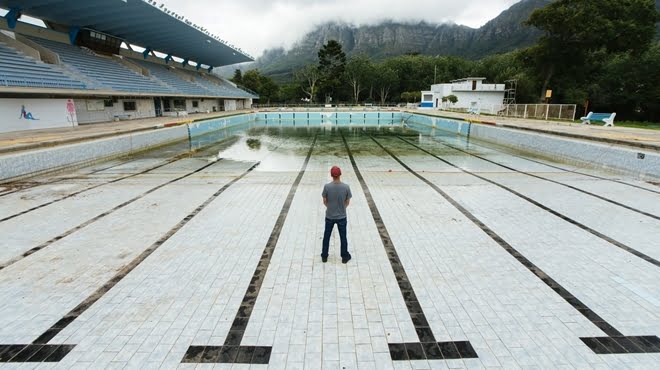
Less than amusing, however, are the impacts on daily life. Welgemoed spells out the stark reality: “Waterless soap has replaced conventional soap. My local shop has quotas on water sales. Usually all water is sold out in an hour after opening. All [the] swimming pools are empty, and public pools have been closed for some time – unless the owners have access to private borehole water. It is prohibitively expensive to put up a borehole and only the rich can afford it.”
Other examples include private hospitals investing in desalination plants.
He adds: “On a daily basis we see trucks delivering water tanks to homes for water that is purchased from springs. The price of tanks has doubled – I am on a waiting list to get one.”
Welgemoed echoes the fears of many with children, in saying “I have no idea what my children will do at school with no water. Imagine 600 kids without flushing toilets.”
He admits there is a “deep irony” here, given that “large communities in townships have been living Day Zero for years” and even when the government does set out ideas, he sees the proposed water collection points as “idiotic”.
He points out: “On a practical level, 50 litres of water weighs 50 kg. Who is going to carry that weight, and how, to where? How will the water be dispensed?”
Such concerns echo other practical water management issues – the BBC’s Allie noted that a free distribution site from South African Breweries site near Newlands had come under security pressures, but with restricted opening hours and water capacity limits, the scheme persists for now. Elsewhere, locals seek water wherever they can source it and save what they can.
Legal community takes stock
There will be an impact on business and for lawyers too. Many law firms, such as ENSafrica, Webber Wentzel, Cliffe Dekker Hofmeyr, Hogan Lovells and NRF are based in Cape Town’s CBD, expected to be one of the last remaining areas in which municipal supply will be guaranteed.
Their current exemption from water restrictions has not led to any lack of effort in reducing the strain on domestic consumers. Merrington spells out her own firm’s preparations: “Most of our staff are already capable of working remotely, and we are engaging with our IT department to ensure that all employees can work at home, if Day Zero affects the CBD.”
She adds: “Measures are currently in place to reduce consumption, including ‘waterless Wednesday’ where the supply to the taps is switched off for the day. We are in discussions with our building manager to establish what other actions can be taken on Day Zero”.
These include, most importantly, the introduction of new hygiene and vacuum systems, “as alternative water sources or systems need to be sourced in order for an office building to operate after Day Zero”.
Likewise, Beech says his firm remains committed to its “green initiatives”, including water conservation, saying “the emphasis is on creating awareness of the consequences of not being able to open the taps freely”.
As does Welgemoed, who notes, even at the most mundane level, as a set of advocates, “we had signs urging water saving in our bathrooms for several months”.
Political difficulties
While challenges to political leadership, inspired by civil society and good governance concerns – from attempts to unseat Cape Town mayor, Patricia de Lille by the Democratic Alliance – to the pressure which led President Jacob Zuma to resign last night – are on-going, the water situation has been a practical problem to manage, with political overtones, rather than a source of political favour.
Announcement of national disaster status will switch ongoing crisis management to the African National Congress-led (ANC) central government, along with the promised extra funding, bringing the incumbent national party into conflict with chief opposition party (the DA) regionally.
Speaking before the announcement, Welgemoed was pithily sarcastic about how contingency plans will work, saying: “Unless I have been under a rock, I don’t think there is one. If so, I certainly don’t know what it is.”
To him, the focus seems to be on disaster management, rather than finding water, although, he notes, mining aquifers and desalination have commenced.
“Why only now is the question on everyone’s lips,” he notes; many ALB spoke to privately suggested that there had been a ‘blame game’ between local and national governments and hence between the DA and ANC as political parties.
Growing need for legal advice
All businesses, of course, in Cape Town face the risks of Day Zero – which in turn, generates a need for legal advice. So far, none of the respondents noted any legal action having commenced over the crisis, thanks in part to Capetonians’ collaborative mind-set.
Merrington says, at present, the focus is on alternative water sources and the legalities behind the different options: “Clients in the property sector are looking at sinking boreholes, and or using recycled grey water and treated effluent water for systems that don’t require potable water.”
She adds: “In addition to our national water legislation, whether water use licences or registration is required, there are occupational health and safety implications, and liability risks, when making use of alternative water sources within a building or office park, and clients want advice on this.”
“Other advice areas include remedies or relief when one party to a contract cannot perform due to impossibility (in this case, not being able to provide water), or on the other side of the coin, any limitations on liability for the party which cannot perform. Insurance and the regulatory space is also important to clients”
Given a hot dry climate, the legacy of drought, and the fierce Cape winds, her words sound a warning: “Think about the consequences of a fire breaking out in an office when the taps are dry.”
Risk management, then, is key, as Beech himself acknowledges: “Proactive businesses are requesting advice in relation to possible penalties and incentives that may be implemented, how incentives can be used to sustain employment, in the event that there is an impact on the business, and, if the worst case scenario arises, what processes need to be followed in relation to potential business rescue, downscaling, and retrenchments.” The stakes are high.