








By Adrian Ephraim
There was a time, not long ago, when Bühler’s Cape Town operation was earmarked for reinvention. Profitability was challenging, and the future of the service station looked uncertain. That story has since been rewritten entirely.
Marc Barris, Bühler Southern Africa’s Technical Adviser, describes the turning point openly: “When we started in Malmesbury and later moved to Klapmuts Gardens, we faced the challenge of not being profitable. Through our commitment and focus, we have transformed this service station into what it is today.”
In its fourth year at its current premises, the Cape Town facility is a recognised centre of excellence within Bühler Southern Africa. Workshop foreman Hugo Bruwer, who has been part of the rebuild almost from day one, captures the shift simply, “Cape Town has now firmly established itself. Where the facility was once largely unknown, it has become a site that many are keen to visit and see firsthand.”
Expanding to meet growing demand
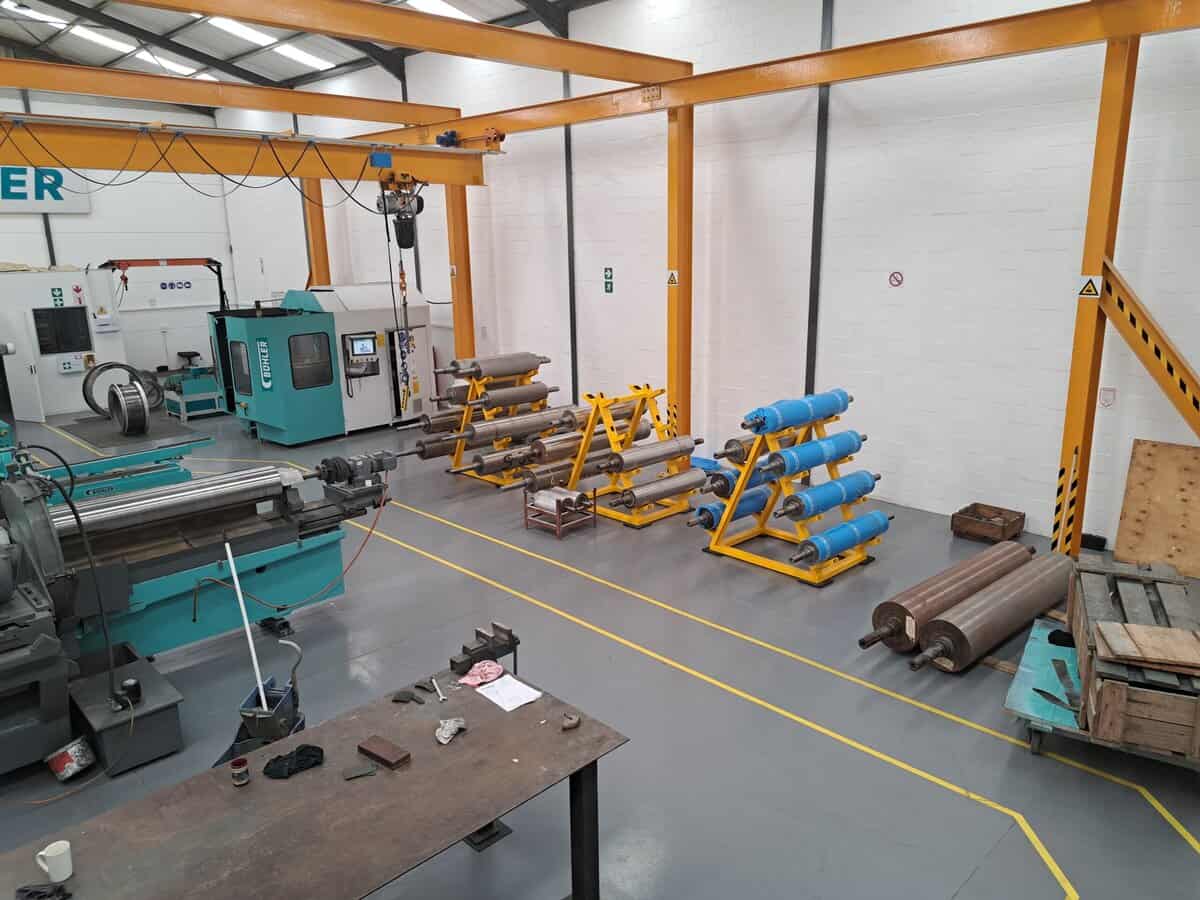
The facility is currently undergoing a significant expansion. The workshop is being reconfigured for a logical production flow. Dedicated incoming and outgoing doors, overhead crane capability, and the capacity to handle Bühler’s latest TVM (Temperature and Vibration Monitoring) milling rolls. Once complete, the Cape Town centre will be the only facility in Africa able to refurbish TVM rolls.
The numbers reflect the momentum. The facility has already refurbished 380 milling rolls this year, a figure set to double when the expansion is fully operational. “The expansion allows us to both services more customers and provide extra services, including the refurbishing of Bühler-manufactured machinery to Bühler standards,” says Barris.
Quality at the core
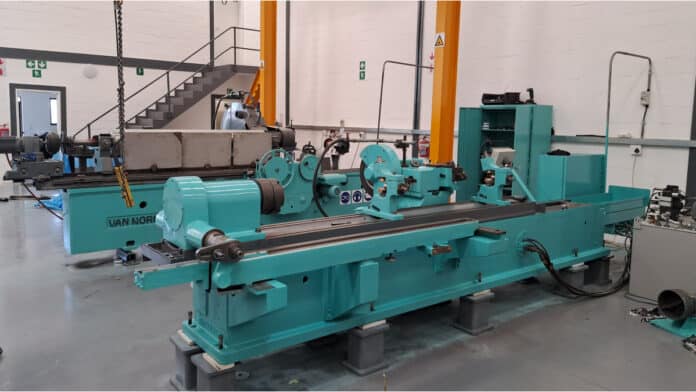
Milling rolls, the cylindrical components with fine spiral flutes that Barris calls “the heart of the mill”, are the facility’s primary focus. The workshop grinds, and flutes rolls up to 2.1 metres in length, producing full-quality control and release documentation for every unit. Alongside rolls, the team services dies, the perforated rings used in animal feed pellet production.
The team overhauled the facility’s ISO 9001 quality system after study visits to manufacturers in Germany and China, tightening tolerances and systematising training. The facility achieved ISO 9001 certification in record time and recently passed its RMA Safety Audit with a score of 98%.
The impact is clearly reflected in customer behaviour. “I recently asked one of our key clients why their roll orders had decreased,” Barris recalls with a smile. “He explained that the quality has improved to the point where they simply do not need to replace the rolls as frequently. In a way, we have reduced our own repeat business, but that is exactly the kind of feedback we want to hear. It confirms that we are delivering lasting performance and real value.” This response, Barris adds, is a strong indicator that the workshop’s focus on precision, quality control, and consistent standards is delivering tangible benefits for customers while reinforcing long-term trust in the service provided.
Bruwer is candid about the competitive landscape: “While some competitors may offer services at a significantly lower cost, our customers face the risk of working with providers who lack a deep understanding of the milling environment. We have the expertise to optimise mill performance, and we know that the rolls are at the heart of that process.”
Innovation, solar, and staying the course
The workshop’s culture of continuous improvement runs deep. When the team identified that their MRBB grinder’s 1.8-metre bed stroke could not handle longer rolls in a single pass, Bruwer proposed extending the hydraulic cylinder, a modification executed with SSM Hydraulics that cut a full day off the processing time per roll. A Wi-Fi timer switch now activates the machine’s hydraulic system at 4am each morning, so it is at operating temperature when the team arrives at 7am.
The facility has also operated entirely on solar power for 11 months. With 80 panels, 230 kW of generating capacity, eight lithium batteries, and four inverters, the workshop has not purchased a unit of electricity since commissioning the system. “We have never missed one deadline,” says Barris. “That is an attribute to this team.”
Barris is clear that the journey is far from over. “It is not as if we have reached a point and now we pause. We are constantly developing new ideas, new ways to make things more efficient, better quality. New technologies are coming, new customer requirements, we look at ways of doing it better, more affordably, and more efficiently. We are constantly evolving.”
For Bruwer, the measure of what has been built here is personal: “Looking back at where we started and seeing what our Cape Town station has become today is, without a doubt, what I am most proud of”.