







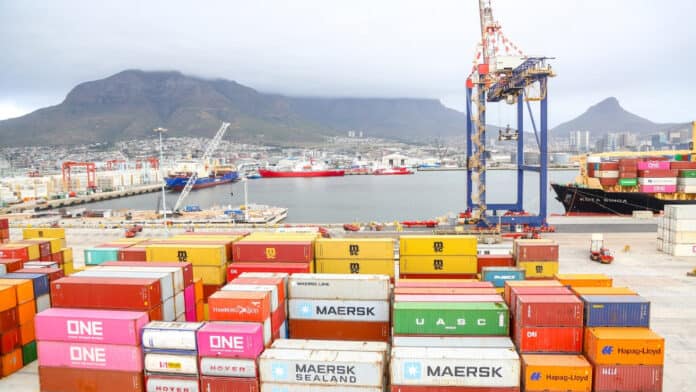
Port of Cape Town operations disrupted by extreme winds despite R3.4 billion investment
By Larry Claasen
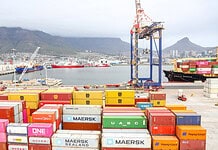
EXTREME winds continue to hurt exports from the Port of Cape Town despite Transnet investing R3,4 billion in rubber-tyred gantries (RTGs) to improve the performance of the port late last year.
The 28 new RTGs, which arrived in September 2025, were meant to optimise operational efficiency and increase volume throughput at the port, which has underperformed as a result of a lack of investment.
Extreme weather is disrupting Port of Cape Town operations
Though designed to cope with wind speeds of up to 90km/h, which surpassed the port’s older RTGs’ maximum operating wind speeds of 72km/h, the port was dealing with winds exceeding 100–120 km/h for much of the summer.
Speaking at a presentation to Parliament early this year, Transnet Group CEO Michelle Philips said although the gantries were designed to operate at wind speeds up to 90 km/h, for safety reasons, they automatically reduce speed at around 80 km/h and shut down completely at 90 km/h or above.
Philips added that for 30 days in November and December, wind speeds exceeded 100–120 km/h, which was unprecedented in recent years.
The extreme winds have persisted into 2025, with the Port of Cape Town losing a total of 1,026 hours between November 2025 and February 2026. Though this is down from the 1,095 hours lost in the same period last year, it compounds the problem for fruit exports, which are dealing with tariff uncertainty in the US and ship availability as a result of the war in the Middle East.
New equipment investments aim to improve Port of Cape Town operations
Philips told Parliament that to mitigate the disruption to port operations brought by the extreme winds, Transnet had secured production slots for two new ship-to-shore cranes with remote operation functionality. She pointed out, however, that no crane can operate safely in winds above 120 km/h.
Aside from the investment in new RTGs, Transnet has also implemented several initiatives to improve efficiency at the Cape Town Container Terminal, such as the addition of a fourth shift to enhance employee wellness, suitable for 24-hour operations.
This has seen the terminal increase its refrigerated container volumes by 32%, as of the end of August 2025, when compared to the same period in the previous year.
Climate research and adaptation plans target Port of Cape Town operations
Transnet turned to the Council for Scientific and Industrial Research (CSIR) in 2023 for assistance in dealing with extreme winds at its ports.
This was especially true for the Port of Cape Town, which in the last few years has experienced an average of 1,200 hours per year.
The project saw University of the Witwatersrand experts study the seasonal climate patterns that result in these extreme winds to establish trends and whether the wind is indeed intensifying with time.
They are also looking into how wind patterns in the Cape Peninsula and the port are likely to change because of climate change.
University of KwaZulu-Natal and University of Cape Town (UCT) researchers are examining the current and future economic impact of these disruptions on specific value chains to estimate the financial losses and assess the required investment in adaptation measures to deal with the problem.