






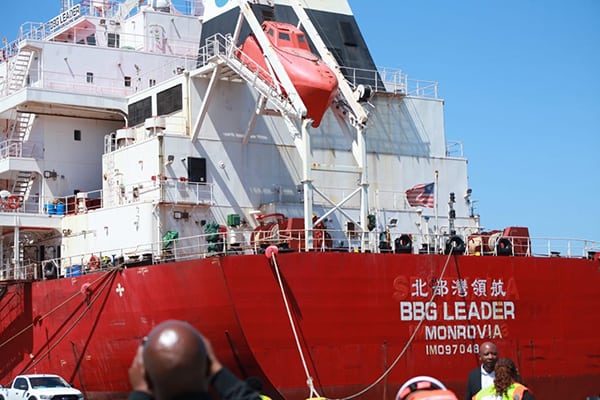
The city of East London received its first export manganese call, Tuesday 3 October, when vessel MV BBG Leader docked to load 30 000 metric tons at the East London Multipurpose Terminal. In preparation, Transnet Freight Rail (TFR) has delivered 16 manganese trains to the terminal since July this year, with plans to fulfil 150 000 metric tons in the current financial year ending in March 2024. The tonnage amounts to one vessel loading up to 40 000 metric tons of manganese per month, which will be via a skip operation that makes use of and the ship’s gear. Transnet is also exploring ramping up East London volumes to 500 000 metric tons from the 2024/2025 financial year.
As South Africa continues to increase its manganese exports each year, the need to create export capacity is in line with Transnet’s segmentation strategies prioritising seven commodities, among them manganese. Plans are underway to establish a dedicated manganese facility in Ngqura long -term with a capacity of 16 million tons. Currently, TFR rails export manganese from mines in the Northern Cape to the Port Elizabeth Bulk Terminal, the Saldanha Multipurpose Terminal and now the East London Terminal. It was important for Transnet to enable industry and unlock demand hence, the varying projects aimed at responding to industry requests.
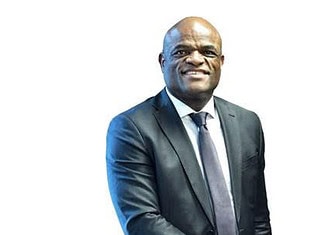
One of South Africa’s top five mining companies that export manganese Tshipi é Ntle Manganese Mining is the first company to utilise the East London Multipurpose Terminal. The company’s Chief Executive Officer Ezekiel Lotlhare said, “We pride ourselves in being part of this historic and significant milestone. Leveraging the capabilities of Transnet and Tshipi presents an opportunity to enhance manganese logistics operations, ensuring more efficient and environmentally responsible transportation of manganese from South Africa to other countries such as China, and India among others”. He added that the partnership signified a new partnership era in the industry. “By utilizing Tshipi’s assets in conjunction with Transnet’s rail assets, infrastructure and the Multipurpose Terminal in East London, we are not only enhancing the efficiency of our operations but also reducing our environmental footprint and negative social impacts associated with road transport”, he concluded.
South Africa hosts about 75 percent of the world’s identified manganese resources, a commodity that has become a key additive in the manufacturing of steel products because it offers superior quality. It is not found as a free element in nature, often in combination with iron. Mined in the country’s largest province Northern Cape, manganese is without a substitute and rather economical with China accounting for over 50% of global consumption followed by India, Japan, Ukraine and South Korea respectively – five of the world’s top ten importers. There have been many exploration and mining projects, policy developments as well as infrastructure developments in South Africa since 2004. The growth of manganese and any future developments can only benefit the country in the long term.