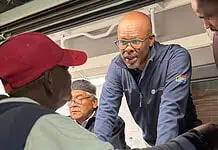







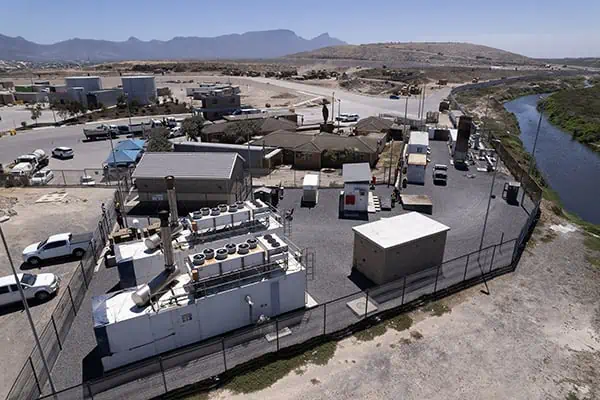
The City of Cape Town’s Mayoral Committee Members for Urban Waste Management and Energy visited the Coastal Park landfill Tuesday, 27 February 2024, to check the latest progress at the waste to energy project on site.
The City of Cape Town Waste to Energy Project is designed to produce electricity from the combustion of landfill gas. Landfill gas, primarily made up of methane, is produced when organic matter such as food scraps break down in the oxygen-depleted environment of the landfill. To convert this gas into electricity, perforated pipes or ‘wells’ have been dug into the landfill site to extract it and channel it as fuel to produce electricity in specially-designed engines.
Before the gas engines can be put into operation, a specialised thermal mass flow meter must still be installed and various regulatory processes must be followed to permit the connection of the engines to the electricity grid. In addition, the City is awaiting delivery of critical spares for the gas engines. All things considered, the estimated date for the first electricity production will be somewhere in the second half of the 2024 calendar year, barring unforeseen complications.
When running at full capacity, the project will produce approximately 15 000 000 kWh/year, which will be used primarily for powering operations and equipment at the landfill site, including the new recycling facility that is currently under construction. The electricity produced will not be sufficient to off-set load-shedding on its own, however it will assist in conjunction with other efforts being made in the Energy Directorate.
While the process to put the gas engines into operation is under way, the City is using a flaring system at the endpoint of the well system to destroy landfill gas before it can enter the atmosphere and contribute to climate change. Landfill gas has a global warming potential estimated to be 25 times higher than carbon dioxide.
The flaring and electricity generation system has been designed in such a way that the destruction of the landfill gas can earn the City ‘Carbon Credits’ in terms of the United Nations Framework Convention on Climate Change-approved (UNFCCC) Clean Development Mechanism and the replacement Article 6,4 mechanism formulated as part of the Paris Agreement signed at the UN Climate Change Conference (COP21).
Basically, these schemes award one carbon credit for each metric ton of carbon dioxide or equivalent that is removed from the atmosphere. These credits can be sold to governments or industries that need to lower their carbon footprint for regulatory or even ethical reasons. In Cape Town, the proceeds from the planned auction of these carbon credits will be ring-fenced to fund projects of the Urban Waste Management Directorate to reduce the health and pollution impacts of waste that will generate additional co-benefits for communities. Find more details here.
‘As we witness the growing impacts of climate change, it’s imperative that we take proactive steps to mitigate its effects. Visiting the Coastal Park landfill and witnessing the progress in converting landfill gas into electricity reaffirms our commitment to sustainable practices. By harnessing renewable energy from waste, we not only reduce harmful emissions but also move closer to a greener, more resilient future for Cape Town. I am proud that the City is leading by example and taking concrete actions to combat climate change head-on,’ said Alderman Grant Twigg, City of Cape Town Mayoral Committee Member for Urban Waste Management.
‘This is yet another example of this City’s game-changing initiatives and forms part of the City’s new Energy Strategy. The City is initiating new dispatchable and non-dispatchable generation assets both connected to the distribution grid, known as embedded generation, as well as connected to the Eskom transmission or distribution grids. This is to harness the energy resources available within the municipal boundary and neighbouring regions. This includes ground-mounted, rooftop and floating solar and waste-to-energy projects such as this one, and the exploration into gas, wind, biosolids and sludge beneficiation, and small hydropower turbines,’ said the City’s Mayoral Committee Member for Energy, Councillor Beverley van Reenen.
View the Cape Town Energy Strategy here: https://bit.ly/Energy_Strategy