










Eskom green hydrogen plan: How ammonia co-firing could cut coal power emissions
Eskom green hydrogen plan: How ammonia co-firing could cut coal power emissions
Green Hydrogen could see coal powered power plants cut CO? emissions by as much as 50%.
ESKOM’s Green Hydrogen venture will see it reduce the carbon footprint of its fleet of coal fired power plants, which are the biggest greenhouse gas emitters in the country.
Eskom’s total greenhouse gas emissions reach about 188,8 million tons of CO? equivalent (tCO?e) annually, representing about 42% of South Africa’s total emissions.
Under the Just Energy Transition (JET) strategy, however, the power utility plans to cut emissions on some gases by as much as 68% by 2035 by closing down some power stations and adopting a host of new technologies.
How ammonia co-firing works
One way it plans to achieve this is by feeding ammonia, created from a Green Hydrogen production process, into the power plant’s boiler alongside the coal. The ammonia burns and provides heat, but because it has no carbon, it doesn’t produce CO?, and the only direct emissions from burning it are nitrogen and water vapor.
This means by replacing a portion of the coal with ammonia, it reduces the amount of CO? coming out of the smokestack.
The pilot programme
Eskom says its pilot programme of co-firing ammonia and coal is showing promise. It has tested co-firing at 5% to 7%, where ammonia replaced 5% to 7% of the coal. It plans to push the ratio test 10% to 20% in the current financial year.
The plan is to eventually push this figure to 50%, which would be a massive reduction in coal use. The group plans to construct a pilot renewable green hydrogen facility (RHF) at its Research, Testing and Development (RT&D) unit in Johannesburg.
Once the Green Hydrogen facility is operational, the green ammonia produced will be used directly for Eskom’s own co-firing production, creating a circular, decarbonised fuel cycle.
Building a local market
Aside from reducing emissions, Eskom’s plans also have the potential to create a local market for Green Hydrogen.
South Africa’s Green Hydrogen plans have largely focused on creating it for offshore markets, but in creating it for local use, Eskom has the potential to foster security of supply, especially in light of the looming “Gas Cliff.”
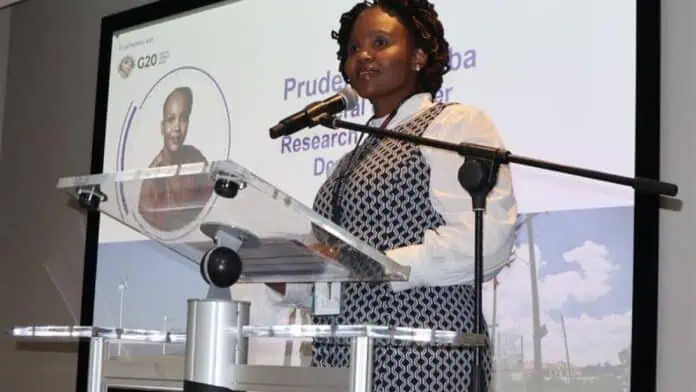
Though the potential is huge, Eskom’s GM for RT&D Prudence Madiba pointed out that it needs local industry to support it as the group as it does not plan to produce Green Hydrogen based products itself.
“Our role is to prove the concept. We need to stimulate the market, and the market needs to respond to help us,” said Madiba.
Beyond Ammonia
Aside from its Green Hydrogen plans, Madiba said Eskom was looking developing Clean Coal Technologies (CCTs) like Carbon Capture, Utilisation and Storage (CCUS); Direct Sorbent Injection Flue Gas Desulphurisation; and High-Efficiency, Low-Emission (HELE) technologies.
Madiba said the group was making progress in developing these technologies.
She said the CCUS feasibility studies were concluded in 2025 and the next stage was to finalise engineering studies for a proposed carbon-capture demonstration plant at Kusile Power Station in Mpumalanga, designed to capture 22,000 tons of carbon dioxide a year.
Madiba said Eskom was looking to produce a range of derivative products from its CCUS projects. Some carbon would be captured to produce fertilizer and at others it would be to produce methanol.
The group has also made progress with HELE, and is expected to have a technology demonstration by 2030.
Besides co-firing ammonia, Eskom is also testing co-firing of torrefied wood pellets and corn biomass. Testing at a 20% co-firing ratio indicated reductions in carbon dioxide and sulphur dioxide, with a full-scale demonstration planned at Kriel Power Station by March 2027.
Coal is not the enemy
Madiba noted that though coal fired power plants have a reputation for emitting greenhouse gases, she pointed out that the use of coal was not the issue but rather emissions were.
She said an argument could be made that by using technology to cap emissions, using coal derived power would not come at a cost to the environment.