








Hartenbos microgrid: Municipal energy independence blueprint
By Adrian Ephraim
SOUTH Africa is witnessing a fundamental shift in how energy infrastructure is delivered – and municipalities are leading the charge.
This is according to DeVilliers Botha, Chief Commercial Officer at Solareff. Speaking after the official launch of the Hartenbos Waste Water Treatment Works Solar PV Plant and Microgrid in Mossel Bay, Botha outlined how the project, which recently won “Top Performing Project” at the AMEU Awards 2025, demonstrates a viable pathway for local governments to achieve energy resilience while generating substantial cost savings.
“The whole country is moving away to what we call distributed generation,” Botha explains. “Before Eskom, before the 1920s, each town and city had their own generation plant. All that’s now happening is that we are shifting towards this opportunity with distributed generation, where Eskom can still play the role of a transmission company, connecting all these systems.”
The multi-million-rand Hartenbos facility represents a sophisticated hybrid grid-tied microgrid spanning 3.5 hectares of municipal land. The system features 4,400 PV panels generating 2.5 MVA of solar capacity, a 4,512kWh battery energy storage system (BESS), and standby diesel generators for ultimate backup resilience.
What makes the project particularly innovative is its dual function. While initially conceived as a load-shedding mitigation strategy, the system has evolved into a significant revenue generator for the municipality.
“The waterworks currently consumes a constant load between 600 and 700 kVA,” Botha notes. “But the plant, on a sunny day, especially at this time around midday, generates at 2.1 MVA. So there’s about one-and-a-half megawatt being exported onto the local municipal grid that creates a saving for the municipality as they don’t need to purchase that power from Eskom.”
From backup to financial benefit
The project’s evolution highlights the adaptability of modern microgrid infrastructure. When load shedding subsided mid-2024, the municipality questioned the system’s continued value. Solareff’s response was to pivot the battery storage strategy.
“We call it arbitrage of the battery,” Botha explains. “During peak hours, we discharge the battery rather than buying from Eskom, because the round-trip cost of charging the battery through the sun on an asset you’ve financed is cheaper than buying from the Eskom grid in those peak times.”
This operational flexibility didn’t require physical modifications—merely control system adjustments. “We didn’t need to change anything on the physical design. It’s just a change on the controller,” Botha says.
The financial benefits have exceeded expectations. “The output or the benefit of the system, the financial benefit, already surpassed their expectations,” Botha confirms, noting that the municipality can now quantify substantial returns on their investment through reduced electricity purchases and optimised energy management.
A replicable model
The Hartenbos success has significant implications for South Africa’s broader energy transition. Botha envisions the model scaling dramatically across municipal contexts.
“You could literally scale this to other municipalities, or instead of just taking a point of connection at waterworks or at a shopping mall, you could go to the central supply of a small town and install such a microgrid system that would supply the full needs of a whole town,” he says.
Solareff is already exploring projects “about 30 times the size” of Hartenbos, targeting irrigation schemes, industrial parks, and entire municipal grids. “This system is currently a two-and-a-half meg PV plant. We’d likely have a 30 to 60 megawatt PV plant supplying either towns or load centres.”
Battery technology economics
Botha also shared an unconventional perspective on battery asset management that challenges traditional thinking about equipment longevity.
“Batteries are the converse of cars,” he explains. “When you buy a car, the chances of needing to replace it in five years, if it’s more expensive, are real. Batteries are becoming cheaper to replace over time. So you should really work that battery, because in five or 10 years’ time, once you’ve worked out those cycles, you can replace it with a cheaper unit.”
This counterintuitive approach – actively cycling batteries rather than preserving them – optimises both operational returns and long-term replacement economics as battery technology continues its rapid cost decline.
Community engagement
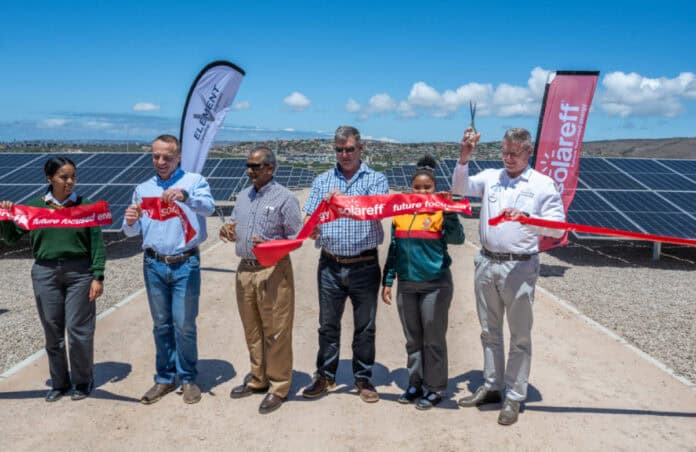
The November 5 launch attracted neighbouring municipal mayors, district representatives, consulting engineers from Element Consulting, and – significantly – local school learners.
“We invited schools. I always like inviting schools to these types of launches for them to see what the systems look like,” Botha says. “The municipal officials were quite pleasantly surprised by the schools being present.”
With the technical and financial validation now established, Solareff’s Hartenbos project offers South African municipalities a proven blueprint: energy resilience, financial sustainability, and community benefit through intelligent infrastructure investment.
For Mossel Bay Municipality, the system represents a revenue-generating asset demonstrating that energy independence and fiscal responsibility can advance together.