







EV Charging stations: CHARGE’s innovative off-grid network
By Diane Silcock
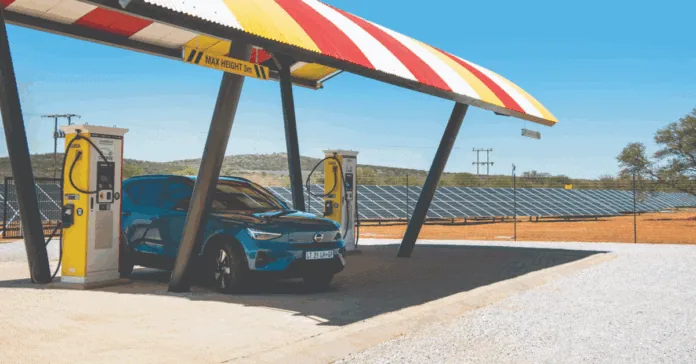
ZERO Carbon Charge’s (CHARGE’s) development of a national network of off-grid, solar powered, ultra-fast electric vehicle (EV) charging stations, has reached a milestone with the pioneering company breaking ground for two new stations along the N3 corridor. This follows the successful launch of their pilot site on the N12 between Klerksdorp and Wolmaransstad.
The Free State site is approximately 180km from Johannesburg, and the KwaZulu-Natal site is just over 180km from the Free State site, and around 200km from Durban.
This milestone has been made possible through the R100 million equity investment CHARGE secured from the Development Bank of South Africa (DBSA) in May 2025. With the uptake in EVs likely to speed up due to lower-priced EVs entering the South African market recently, the investment came in the nick of time for CHARGE to step up development of their planned national rollout of South Africa’s first network of 120 off-grid EV charging stations.
CHARGE’s decision to focus on long distances emanated from determining, through the government’s collection of data on South African roads, that the greatest need for EV charging stations for passenger vehicles is outside of cities and towns. It was substantially more than they could have imagined: the average daily car count on the N3 between Durban and Johannesburg is 7,500, and the N1 experiences similarly significant volumes — with northbound traffic exceeding 18,000 cars on busy days, and southbound flows often reaching close to 7,000. The statistics they reviewed also indicated that 49% of transport energy for passenger vehicles is consumed outside of the big cities.
“We are very excited to have broken ground and that two new stations will be completed in 2026,” says CHARGE Co-founder and Director Andries Malherbe. “Thereafter, we will likely build the next 30 stations the following year.”
CHARGE has been particularly innovative with their business model. Realising that the electricity grid was not designed to pull vast amounts of power to put into vehicles, it made sense to them to use solar power especially with their background in renewable energy, plus the environmental aspect. Another important factor they considered was charging time, and for long distances ultra-fast charging is essential.
A major part of CHARGE’s work over the last few years has been in securing sites, signing them up, and developing their network. “We have signed up approximately 150 sites across the country of which 120 are in development. We plan to have eight charging outlets at each site, with six DC charge points and two AC chargers,” says Malherbe.
The novel concept of a farmstall at the charging stations has been a win with CHARGE’s idea being to showcase that area’s local produce coupled with being a source of employment opportunities for people in the local communities. For travellers, it provides a unique experience offering them a great place for a break from travelling, a cup of coffee and local food, fast WiFi, and very good bathroom facilities.
Malherbe says that the picture around EVs is not static. As technology and electric vehicles evolve, CHARGE will enhance and upgrade their equipment to meet the evolving needs of the industry. “The way we have structured our business, gives us complete control of the power distribution—never being subjected to load shedding—with robust battery backup ensuring reliability, and a generator providing additional resilience when needed.”
CHARGE is aiming to source all of their equipment locally (besides photovoltaic panels), and Malherbe expects that this objective will become a reality in the not too distant future. He too believes that South African car manufacturers need to build electric cars to meet the needs of their global customers. He says, “In most countries now, EV sales—as a percentage of new car sales—are somewhere between 20% and 30%. EVs are going to be a part of our lives going forward.”
CHARGE’s decentralised energy model not only accelerates the decarbonisation of South Africa’s transport sector but also sets the stage for a green-powered transport revolution, supporting large-scale EV adoption with clean, locally generated energy.