






By Adrian Ephraim
South Africa has quietly flipped the switch on one of its most ambitious energy projects to date – the Redstone Concentrated Solar Power (CSP) plant in the Northern Cape. And with that, the country has staked its claim as a serious contender in the global race for dispatchable renewable energy.
The 100 MW facility, developed by ACWA Power in partnership with the Central Energy Fund and the Industrial Development Corporation (IDC), is the first of its kind in Africa to deploy tower-based CSP technology with molten salt storage. More than a technological milestone, Redstone represents a shift in thinking: from adding megawatts to the grid to building grid resilience and reliability in a volatile energy landscape.
A solar plant that doesn’t sleep
The core innovation behind Redstone CSP is its thermal energy storage – an elegant solution to one of renewable energy’s most pressing challenges: intermittency.
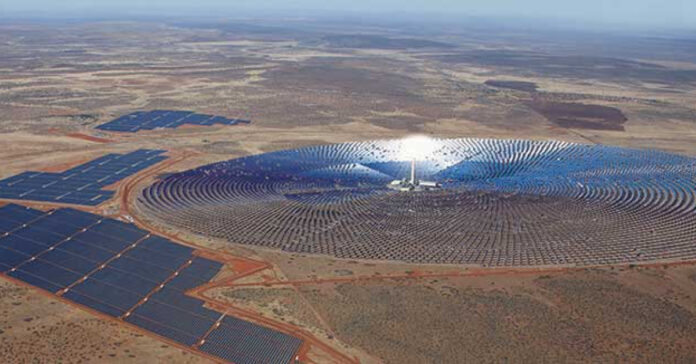
Using over 12 000 heliostats to concentrate sunlight onto a central tower, the plant heats molten salt to temperatures exceeding 560°C. The stored heat is then used to produce steam and generate electricity for up to 12 hours without sunlight, delivering baseload-like performance that’s traditionally been the domain of fossil fuels.
In practical terms, that means Redstone can power over 200 000 households day and night, without relying on coal or diesel peakers. And for a country wrestling with energy insecurity and an ageing coal fleet, the implications are significant.
Local jobs, global innovation: The Redstone impact
Located near Postmasburg in the Northern Cape – a region rich in solar resources but historically underdeveloped – the project is also a statement of industrial intent.
During construction, Redstone created over 2 000 jobs, with local content making up a substantial portion of the supply chain. Among the standout contributors was Steel Xperts, a South African engineering firm that designed and built the plant’s complex molten salt storage tank – a first for the local industry and a benchmark for local manufacturing
capacity.
At 250 metres, the tower itself is now the tallest CSP structure on the continent, underscoring the scale and ambition of the project.
Redstone CSP’s $800m milestone
Getting to this point wasn’t easy. With a total investment of over $800-million, Redstone’s financial close in 2021 marked a critical milestone not just for the project but for investor confidence in South Africa’s Renewable Energy Independent Power Producer Procurement Programme (REIPPPP).
Support from multilateral development banks was essential. The African Development Bank (AfDB) contributed $50-million in senior debt, while the Development Bank of Southern Africa (DBSA) backed the project with $88-million – one of the largest commitments to a single renewable energy asset in South Africa to date.
Their participation wasn’t just about funding – it was a vote of confidence in CSP as a long-term solution for energy storage in Africa.
Redstone as a grid game-changer
Unlike wind or PV solar, CSP with storage offers dispatchable power that can be scheduled and dispatched according to demand – a feature that becomes invaluable in a grid plagued by variability and outages.
As load shedding continues to disrupt economic activity, Redstone CSP sets a new benchmark for what’s possible when energy reliability meets clean innovation. It also supports the Just Energy Transition, offering an inclusive model that addresses both decarbonisation and local economic development.
Can Africa replicate Redstone’s CSP success?
The launch of Redstone raises a bigger question: can this model be replicated elsewhere on the continent?
The answer may hinge on more than sunlight. South Africa brought together deep institutional capacity, a maturing procurement framework, and strong financial partnerships to get this over the line. Replicating that alignment won’t be easy, but Redstone has proved it’s possible – and economically viable.
For a continent rich in solar potential, the plant is more than an engineering feat. It’s a strategic proof point for how Africa can leapfrog legacy infrastructure and build a sustainable, secure energy future on its own terms.