










A call for greater collaboration: Industry needed to unlock South Africa’s nanoscience potential

Two decades ago, the Department of Science and Technology recognised nanotechnology as a strategic field capable of reshaping South Africa’s industrial future. This led to the establishment of the Masters Nanoscience Programme, a collaboration between four universities designed to train MSc graduates who can drive innovation, manufacturing and technology development locally rather than relying on imports.
Why nanoscience matters
Nanoscience focuses on materials measured in nanometres, structures at least 1,000 times thinner than a human hair. Its applications span chemistry, physics, biomedicine, electronics, petrochemicals, manufacturing and environmental solutions.
“The biological applications of nanoscience have spurred remarkable growth in biological science companies in the Western Cape, something that few people seem to be aware of,” says Professor Robbie Lindsay, national director of the programme.
Nanoscience is also becoming essential in efforts to reduce carbon emissions. Advanced nanomaterials are improving energy efficiency, enhancing catalytic processes in petrochemicals, enabling cleaner manufacturing, and powering next-generation filtration and carbon-capture systems. These innovations reduce emissions while boosting industrial competitiveness, positioning nanoscience as a key enabler of South Africa’s transition to a greener economy.
Success stories showing the programme’s impact
Graduates of the programme work at several successful companies in the Cape, offering clear proof of the growing local nanotech industry and the programme’s relevance and impact:
- Bio-Vac manufactures vaccines locally.
- Medical Diagnostics in Brackenfell develops advanced diagnostic tests.
- Synexa, a company that specialises in advanced bioanalytical measurements, has expanded beyond South Africa into Europe and the USA.
- Kapa Biosystems, developed by South African researchers, was acquired by Roche, which subsequently invested in a major Cape Town facility.
These examples show how nanoscience skills and research can translate into value-added manufacturing, new exports, and globally competitive businesses.
Opportunities for business – and young scientists
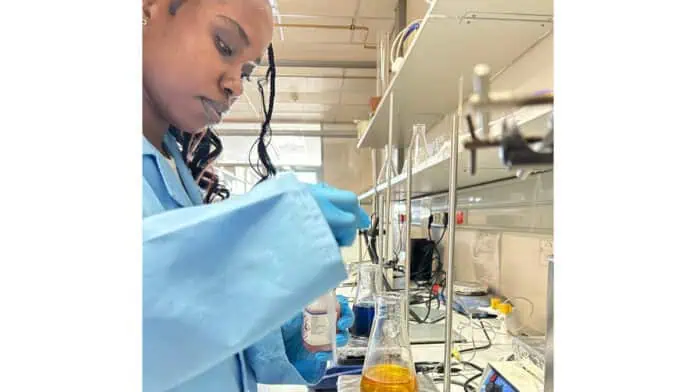
For students, the programme provides far more than academic learning. Funded traineeships give graduates real-world experience in tackling industrial problems, preparing them for careers in fast-growing technology sectors.
One standout example is the partnership with Stellenbosch Nanofibers Company, which manufactures nanofibres at scale using technology initially developed at a South African university. “This company shows how research can transform into industry,” says Lindsay. “It’s exactly the kind of environment where a nanoscience graduate can thrive.”
For businesses, collaboration offers several advantages:
- Access to specialised scientific expertise
- Joint research and innovation opportunities
- Practical solutions to local industry challenges
- A pipeline of trained graduates ready to contribute immediately
Companies can strengthen their Research & Development capabilities without the cost of establishing large in-house research units.
The critical challenge: Too few industry partners
Despite strong foundations, the programme’s growth is now held back by a shortage of internship and traineeship opportunities, the essential bridge between academic expertise and industry application.
“We don’t have enough internship opportunities for the students we have in the programme,” Lindsay explains.
This shortage has become a bottleneck at a time when South Africa urgently needs to expand value-added manufacturing and technical innovation. At the recent Export Symposium and Expo in Midrand, Deputy Minister of Trade, Industry and Competition, Zuko Godlimpi, highlighted that South Africa’s export basket remains too dependent on raw materials and too concentrated in a few markets.
The Masters Nanoscience Programme is one of the clearest pathways to building a more diversified, knowledge-driven and competitive economy, but this requires far greater industry involvement.
A direct call to business: Partner with the programme
The programme invites collaboration from companies across sectors, including advanced manufacturing, pharmaceuticals, biotech, petrochemicals, mining, energy, agriculture, environmental technologies, water management, electronics, and food and packaging.
Opportunities include:
- Hosting interns or trainees
- Joining collaborative research projects
- Identifying real-world problems for student research
- Supporting innovation that strengthens industry competitiveness and export potential
Businesses that engage now will help shape South Africa’s scientific and industrial future while benefiting from early access to a growing pool of highly trained graduates.
With stronger collaboration, South Africa can transform small particles into strong possibilities, powering a more innovative, competitive and sustainable economy.
Companies interested in partnering are encouraged to contact the Masters Nanoscience Programme at UWC.
Robbie Lindsay Director, NanoScience
+27(0)82 202 3593