










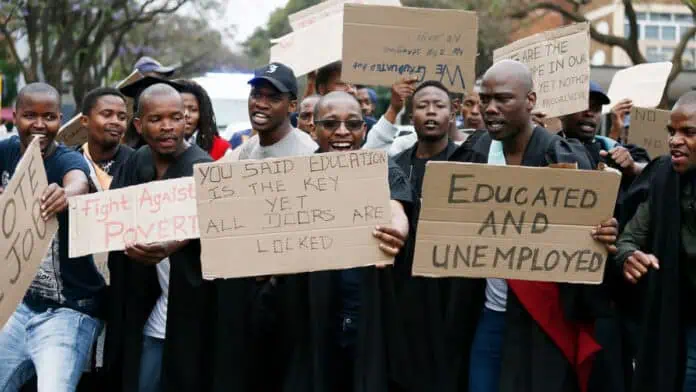
Youth unemployment South Africa demands a rethink
By Adrian Ephraim
WHILE Statistics South Africa’s latest quarterly employment figures show unemployment declining to 31.9% with 248,000 jobs added, youth employment specialist Nkosinathi Mahlangu warns against premature celebration. The Momentum Group expert points to a more sobering metric that reveals the true depth of South Africa’s jobs crisis: labour underutilisation remains stubbornly high at 44.9%.
“We take every victory, we embrace every victory,” Mahlangu acknowledges. “However, looking at the numbers, what I’ve picked up over the years is that Q3 and Q4 seem to have a certain pattern, with specific sectors that usually pick up during this time of year.”
The concerning reality behind the headline figures is that construction and trade sectors, driving recent job growth, aren’t creating opportunities for young people. “These jobs require someone with experience,” Mahlangu explains. “In most instances, these are individuals over the age of 35. The question becomes: how are we making sure these sectors also create opportunities within the entry-level space for unemployed youth?”
The informal economy: From fallback to foundation
Stats SA’s recent revision of how it defines and measures the informal sector marks what Mahlangu calls “the low-hanging fruit that has been missed over the years.” The informal economy has been growing rapidly as economically inactive South Africans seek ways to make ends meet, yet it has largely operated beneath the radar of official measurement and policy support.
“The informal sector plays a pivotal role in getting young people economically active and gaining that much-needed experience,” Mahlangu argues. But transforming it from a survival strategy into a genuine engine for youth entrepreneurship requires fundamental shifts in how government and business approach it.
He recalls President Ramaphosa’s commitment two years ago to reduce red tape for entrepreneurs. “For the informal sector to play a meaningful role and not be considered as a fallback, we need the government to ensure the environment is conducive for it to thrive. It should not be looked at as a competitor to the formal sector but as having a role to co-exist.”
The skills alignment crisis
At the heart of South Africa’s youth unemployment challenge lies a critical mismatch between education and economic demand. Young people are “left to figure it out for themselves,” making career choices based solely on what they’ve been exposed to, Mahlangu observes.
“They go to higher institutions of learning and get qualifications only to find that those qualifications do not translate into immediate employment,” he notes. The solution requires earlier intervention in career guidance, starting at high school level, combined with better alignment between training institutions and sector demands.
Each sector needs to communicate its three-to-five-year skills requirements clearly, allowing education providers to channel students toward qualifications that match market needs. This applies equally to universities and TVET colleges, where artisan training that includes workplace experience creates work-ready graduates.
Provincial disparities demand localised solutions
The Eastern Cape and North West provinces consistently register the highest unemployment rates, with numbers that haven’t shifted significantly quarter-on-quarter. Rather than perpetuating urban migration patterns that see young people flood into Johannesburg chasing opportunities, Mahlangu advocates for identifying and developing key economic drivers within these provinces.
“We need to have skills audits to say how far or how big the gap is between the skills that have been acquired and what their market is demanding in those respective areas,” he explains.
From temporary to permanent: Breaking the cycle
The blueprint for creating sustainable youth employment pathways already exists in internship and learnership programmes, but the value chain breaks down at completion. “We wouldn’t need a cycle whereby from an intern you’re back into the cycle again, becoming a statistic that says I’m unemployed now, I’m upskilled but I’m unemployed,” Mahlangu warns.
He proposes incentivising corporates to convert temporary positions into permanent employment when young people are kept as interns or contract workers beyond a year, demonstrating the ongoing need for their skills.
Momentum Group’s own programmes in cybersecurity, software development, and data science demonstrate this model’s viability, with interns being absorbed as permanent workforce. “If we have seen that happening in our space, we are optimistic this can be replicated and scaled across sectors,” Mahlangu says.
His advice to young South Africans entering the job market today is pragmatic: be focused on long-term goals, use each opportunity as a stepping stone, continuously upskill using internal corporate resources, and leave the door open for those following behind.
“There is a space for young people in our environment,” he concludes. “But we cannot do this alone.”