







EV Charging Infrastructure South Africa: Where is it heading?
By Robin Hayes
THE EV landscape in SA has changed dramatically over the past few years with offerings from premium OEM’s to highly competitive Chinese and Indian brands that offer tech rich vehicles with range rivalling those of ICE vehicles due to advances in battery energy density. Top performing commercial lithium-iron cells have nearly doubled in energy density over the past decade, rising from around 160Wh/kg to nearly 300Wh/kg.
And the development of crucial charging networks is driven by similar technologies – without many tangible incentives from our Government despite commitments to reduce our carbon footprint where transport could make a vital contribution.
Nevertheless there are plenty of entrants in SA’s EV charging space – 26 at the last count according to participants Breev whose MD Shaun Maidment explained to CBN the somewhat complex landscape of operators/owners of charging stations, whether AC or DC, main routes, dealer facilities, destination charging – in fact, according to Maidment, there are seven distinct categories, each attracting infrastructure owners, operators or a combination of both.
Distinct categories
These include: home charging, workplace charging AC, destination charging AC, destination charging DC, passenger travel (long distance intercity), passenger solar offtake hubs and commercial – usually long distance and intercity destinations – each with a different business model, management and profit criteria.
Those expecting to get rich quick by entering this competitive environment are likely to be disappointed even though the capital cost for charging hardware has been declining, maintaining the essential hardware and software for charging performance and payment facilities requires skilled acumen that is in short supply and hence a major barrier to entry.
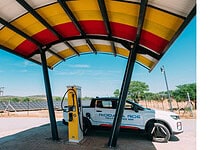
While the (hopeful) end to 14 years of Eskom load shedding gives everyone a little more enthusiasm for EV ownership and accordingly, the business of an expanding EV charging network, it is the implementation of solar installations through private and business adoption that has added more than 5GW to the national grid. The capture of excess generating capacity by power wheeling is a major benefit to charging network rollout says Maidment, who’s vision is to have affordable charging facilities in every town in the country.
Solar not always the panacea
Breev’s business modelling indicates that stand-alone solar powered EV charging is unlikely to be financially feasible for remote guest, game farms and other tourist attractions but having EV charging facilities as an added attraction to an existing or extended solar installation means that EV owners can confidently take on trips further afield than just the daily city commute.
While there is a slow uptake in the sales of EV’s due to the high cost of premium offerings and the introduction of hybrids (which provide additional range security, albeit at a cost), industry experts estimate that the price of average EV models will be at a price parity with ICE vehicles by 2030 which is just around the corner for those contemplating the purchase of a new vehicle.
The reality of significant market penetration by Chinese and Indian brands has not been lost on big players such as BYD who compliment their vehicle offerings with a committed to investing in charging infrastructure while another as yet unnamed Chinese investor has secured a majority stake in GridCars, South Africa’s biggest EV charging network player.
Watch this space.