









South Africa’s Logistics Recovery: Will 2026 Be the Turning Point?
Major reforms launched in 2025 begin to deliver tangible outcomes in 2026
South Africa’s logistics crisis has come at a significant economic cost. According to synthesis data compiled by The Geography of Transport Systems, based on World Bank and international logistics datasets, logistics costs can account for up to 25% of GDP in developing economies, compared to around 8% in advanced economies. This underscores how transport and logistics systems directly influence economic competitiveness.
That pressure is now beginning to translate into action, with reforms introduced in 2025 starting to show measurable impact in 2026, as the sector moves tentatively from prolonged decline toward early recovery.
Central to this shift is the implementation of the Freight Logistics Roadmap, which opened rail and port systems to greater private sector participation. This included the move toward open-access rail and the licensing of private train operating companies on strategic corridors.
Governance reforms within Transnet, including the Transnet Rail Infrastructure Manager model, have also separated infrastructure oversight from operations, creating clearer access and pricing structures. At the same time, Transnet accelerated targeted recovery measures focused on maintenance, equipment availability and security at ports.
“While these reforms have not delivered instant transformation, but they have shifted the system from decline to early recovery,” says Paul Vos, Regional Managing Director of the Chartered Institute of Procurement & Supply (CIPS) Southern Africa. “Reliability and planning confidence are beginning to improve, even if performance remains uneven.”
At a practical level, the changes are moving the logistics system away from constant crisis management toward more predictable operations. Congestion and delays remain, but businesses are increasingly able to plan around constraints rather than react to repeated breakdowns.
“In 2026, predictability has become more valuable than speed,” says Vos. “Businesses can manage known delays far more effectively than uncertainty and volatility.”
This trade-off is reshaping supply chain strategy. Companies are increasingly prioritising stable scheduling, reliability and resilience over marginal gains in transit times. The shift is also changing how procurement teams approach logistics and supplier decisions.
“Procurement is no longer simply managing cost,” Vos explains. “Teams are reassessing supplier locations, diversifying routing options and building more flexibility into contracts to reduce logistics risk.”
Multimodal transport strategies (integrating road, rail and ports) are also gaining traction as businesses seek alternatives to single-mode dependency. While still uneven, certain corridors are beginning to demonstrate the value of integrated logistics models, particularly as port performance stabilises.
Development finance is playing a key role in supporting this recovery. Funding initiatives backed by institutions such as Agence Française de Développement (AFD) are helping unlock infrastructure projects while enabling greater private sector participation in freight capacity and logistics delivery.
According to Vos, the significance of private participation extends beyond funding alone.
“It is introducing additional execution capability, stronger delivery discipline and greater focus on operational outcomes,” he says. “That is critical in a system where implementation has historically lagged behind planning.”
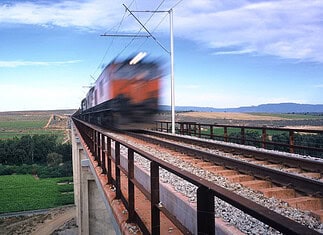
Despite encouraging signs, rail recovery remains considerably slower than progress seen in ports. Structural issues including ageing infrastructure, long rehabilitation timelines, operational complexity and institutional capability constraints continue to limit turnaround speed.
“Rail recovery is a long-term intervention, not a short-term fix,” says Vos. “Its strategic importance is enormous, but meaningful recovery will take sustained investment and consistent execution over several years.”
The recovery momentum also remains vulnerable to disruption. Risks include inconsistent implementation of reforms, delays in infrastructure delivery, funding constraints and insufficient follow-through on private sector participation. External shocks such as labour disruptions or infrastructure failures could quickly erode gains if reforms stall before becoming operationally embedded.
“The progress is real, but it is still fragile,” Vos cautions. “The real test now is whether South Africa can sustain the discipline and execution needed to turn early recovery into long-term competitiveness.”
For procurement and supply chain leaders, the implications are increasingly clear: logistics resilience can no longer be treated as a downstream operational issue. It is becoming a strategic capability that directly influences sourcing, inventory management, supplier relationships and business continuity.
As South Africa’s logistics reforms begin moving from policy into practice, 2026 may not yet represent full recovery but it could mark the point where confidence slowly starts returning to the system.