







In what could be an important breakthrough in South Africa’s transition to EV’s (electric vehicles), the technology described below could hold enormous promise.
Forgetting for a moment the two negative aspects of EV’s in SA – initial cost and how the government will ‘reclaim’ lost fuel revenues amounting to hundreds of billions of Rands, the role out of charging infrastructure particularly in rural areas and Eskom’s inability to provide a stable electricity supply, could be addressed in whole or in part by this Australian development. Ed.
VSUN Energy has completed the first phase of a trial of battery technology that could deliver a truly green charging network for electric vehicles.
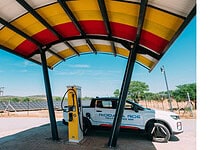
The trial involves the use of a small 5kW-30kWh Vanadium Redox Flow Battery (VRFB) powered by solar energy. The project opens the way for standalone EV charging stations anywhere in Australia or perhaps South Africa too.
VSUN Energy’s Business Development Manager Zamien Sumich said VRFBs were the “missing piece of the renewable energy jigsaw”.
They claim it can handle all the requirements of EV charging but can also be scaled up to suit a wide range of projects, from residential through to large grid-scale industrial and agricultural needs.
“The VRFB is well suited to the capture and storage of large quantities of renewable energy, enabling stable power output,” Mr Sumich said.
“Vanadium electrolyte doesn’t degrade, meaning that thousands of EV batteries can be charged from the one station.
“The VRFB’s long life, exceeding 20 years, makes it one of the most sustainable and long-lasting ways of storing renewable energy. At the end of the battery’s mechanical life, the vanadium electrolyte can be reused indefinitely.”
VRFBs can handle high temperatures without the risk of explosion.
Even the most remote EV charging point can be powered using renewable energy.
VSUN Energy, the renewable energy generation and storage subsidiary of Perth-based Australian Vanadium Limited, is collaborating with its Singaporean partner V-Flow Tech and EV specialists Gemtek on the project.
ASX-listed AVL is developing the Australian Vanadium Project south of Meekatharra. The Australian Vanadium Project is more than a vanadium mine, comprising a value chain spanning mining, manufacturing and downstream processing.
AVL Managing Director Vincent Algar said the initiative is part of the company’s strategy to further develop the market for the battery storage technology in Australia and elsewhere.
“The intent is for Australian Vanadium to not just sell vanadium into the metals sector internationally, but to be fully vertically integrated onshore here in Australia. In doing so, we are able to reduce the cost of these batteries while adding local value, content and job creation,” said Mr Algar.
“While we are still in the development phase of the mining project, we are building a vanadium electrolyte manufacturing facility near Kwinana, which is expected to be in production by mid-2022 with an annual production of 33MWh.
VSUN Energy has partnered with Electric Vehicle charging hardware and software provider Gemtek Goup for the trial.