









Cape Town desalination plant: R5bn water security for industry
By Adrian Ephraim
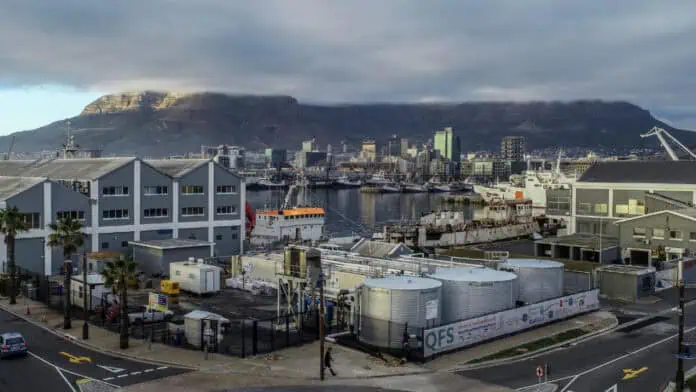
CAPE Town’s ambitious R5-billion Paarden Eiland desalination plant is positioning the city as a manufacturing powerhouse capable of outpacing Gauteng’s infrastructure unreliability, with water-intensive industries set to benefit from climate-independent supply by 2030.
The facility, which will convert 50 to 70 million litres of seawater daily into drinking water using advanced reverse osmosis technology, forms the cornerstone of Cape Town’s New Water Programme – a strategy to add 300 million litres per day from diversified sources including groundwater, water reuse, and invasive species clearing.
“Adopting water-wise operations needs to remain top of mind for industries regardless of capacity,” said Councillor Zahid Badroodien, Mayoral Committee Member for Water and Sanitation. “However, the Desalination Plant will enable economic growth within the City of Cape Town, including the expansion of industries.”
The city’s food and beverage sector – comprising 3.6% of Cape Town’s gross value added and employing major players like South African Breweries, Rhodes Food Group, and Peninsula Beverages – stands to gain most from guaranteed water security. Food and beverage manufacturing is Cape Town’s largest industrial subsector at 26%, followed by petroleum and chemical products at 25%.
But the investment comes with a price. Tariff modelling reveals an approximate 6.57% real increase in 2030/31 and 6.63% in 2031/32 for the desalination project alone, though officials note tariff smoothing could mitigate impacts when considered alongside other portfolio projects.
“All capital projects impact tariffs due to costs,” Badroodien acknowledged. “They are a smart investment to secure water and avoid significant detrimental economic impact associated with exposure to climate change and droughts.”
The energy challenge looms large. The plant will rely on grid supply with energy recovery devices incorporated to reduce consumption, though no dedicated renewable integration has been specified – a notable gap given Cape Town’s R120-billion 10-year infrastructure pipeline emphasising climate resilience.
The city has appointed a multidisciplinary Independent Advisory Panel of international and local experts, which determined that most desalination plants globally operate under private management due to process complexity. Following this guidance, Cape Town recommends a 20-year public-private partnership where the private party designs, finances, builds, operates and maintains the facility before transferring it to the city.
International case studies from Perth, Tel Aviv and Singapore informed this approach, with lessons extracted from Cape Town’s own temporary desalination installations at Strandfontein and the V&A Waterfront during the 2018 Day Zero crisis.
“The drought taught Cape Town that it is vital to diversify our water sources and not depend on rain-fed dams,” said Badroodien. “Building more dams will not provide more water security, as we will still need to depend on unpredictable rain.”
The project timeline shows construction starting after completion of the Section 78 Municipal Systems Act study currently underway, with procurement opportunities expected to reach the market in 2027. The facility presents business opportunities spanning water-treatment systems, chemical supply, membrane maintenance, and civil engineering works – creating approximately 30 direct jobs and 100-150 indirect positions.
For Cape Town’s manufacturers, the desalination plant represents more than drought insurance – it’s a competitive advantage against Johannesburg’s persistent water and electricity challenges. The city’s infrastructure investment rate outpaces Johannesburg and Durban combined over the next three years, with R43-billion allocated.
The plant is designed to maximum capacity with no explicit expansion provisions, though it forms part of a broader water resilience portfolio addressing anticipated growth in consumption. Public consultation on the external service delivery mechanism closed in March 2025, with Council decisions pending.
As Cape Town positions itself as Africa’s most infrastructure-reliable metro, the R5-billion desalination bet signals a fundamental shift: water security is no longer just about preventing Day Zero – it’s about powering industrial expansion in an era where climate volatility defines competitive advantage.