












The National Energy Regulator of South Africa (NERSA) has approved an Eskom electricity increase of 15.63% for this year. This increase was implemented on 1 April 2021 for electricity consumers being supplied directly by Eskom. For the remainder of South African electricity consumers, these new rates will take effect on 1 July 2021.
(Important Note: Local municipalities can also apply to NERSA for further tariff increases in addition to the already-approved national increase. Municipal residents are therefore strongly advised to contact their municipalities to confirm exactly what their expected increase will be.)
Instead of simply swallowing the lump in our throats and moving on, we decided to put this increase into some much-needed context for electricity users. What was the price of electricity 10 years ago? How much and at what rate are tariffs increasing? Is this year’s increase extraordinarily high or simply “par for the course”?
The below graph and table, compiled from Eskom’s website and Homepower tariffs, help to put things into perspective:
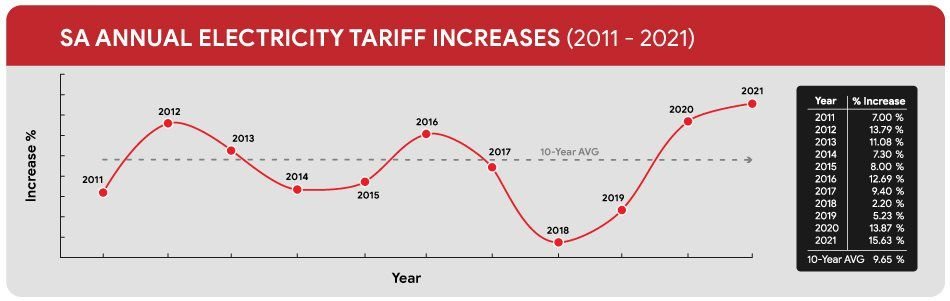 |
From the graph above, it’s clear to see that 2021’s increase will be the highest of the past decade. Not only that, but it is also seven times more than the 2.20% increase in 2018 – not too long ago. This year’s increase % will also come in 50% higher than SA’s 10-Year Average which is sitting at 9.65%.
If you’re an electricity consumer in South Africa, the above is far from joyful reading. But what do these numbers and graphs mean to us practically – in terms of our wallets? At the end of the day, that’s all that “really” matters, right?
Let’s say you use a set number of electricity units each month and paid a R1,000 for those units back in 2011. If you still use the same number of units in your home, how much will you pay for your electricity today? The answer is R2,736.03. That’s a 173% increase in the space of just 10 years! Add this to the fact that people’s salaries simply can’t keep up with this blistering pace, and you’re sitting with a real problem…
How does electricity’s price curve compare to increases in other industries? In an article published on IOL in March 2021, Jason Woosey explored and illustrated petrol’s journey through the last decade, with the results indicating an increase of 70% in SA’s petrol price over the past 10 years – not even half of that of electricity. So, it’s clear to see that electricity is not only following a national trend with regards to price increases but is in fact setting the pace!
What can electricity users do?
From what we’ve read above and “felt in our pockets” over the past few years, it’s clear that electricity prices are only on the way up. As a consumer, these are challenging times indeed. Apart from everyday thriftiness like switching your geyser off when it’s not in use, cooking with gas (if possible) and making sure that the kids don’t leave their rooms’ lights on during the day, there aren’t many other viable alternatives to help make ends meet in terms of electricity expenditure – apart from going full solar, which very few people can afford to do!
Few companies are more in touch with national and local municipal electricity tariffs than Prepaid24, South Africa’s top-rated independent online electricity vendor. Ben Lindeque, Prepaid24’s business architect and co-CEO, had the following to say when asked what electricity users can do to try to negate the effects of the country’s ever-rising tariffs:
“We can provide electricity consumers with a slight glimmer of hope and a way to at least soften the blow of this year’s electricity increase. If their current municipal tariff structures allow it, users can decide to purchase some extra electricity during the remaining days of June and, by doing so, acquire additional units at the current lower rate. A typical example of someone employing this strategy before a price-hike would be as follows:
“A client who would typically buy R2,500’s electricity every month may decide to make a R5,000 purchase in June. They would then use the extra R2,500’s units in July and only make a purchase again in August. The effective saving on the additional units purchased will then be the percentage (%) of the price increase – in this case, 15.63%, or R375.
“We have even seen some of our clients purchase four or five times more than usual in order to save as much as they possibly can on electricity in the months following the tariff increase.
“Since Prepaid24 started selling prepaid electricity almost 10 years ago, this is something we have seen many of our clients do and is a trend we expect to see continue. It does not solve the long-term issue of increasing electricity prices, but it most certainly does help clients to stretch their rands further.”
So, amongst what seems to be only bad news, there are one or two strategies and solutions that South Africans can employ. Apart from that, we can only hope that Eskom’s turnaround is imminent and that the above graph starts reversing on itself within the years ahead.
To contact Prepaid24 and speak to a professional electricity consultant, kindly visit: Prepaid24 Support. They’ll be more than happy to assist you in determining your current municipal tariff structure and advise you on how to optimise your spend before (and even after) this year’s electricity price increase. Prepaid24’s website can be reached on www.prepaid24.co.za.