


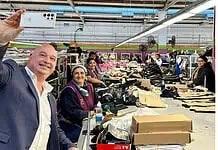











Real-Time Data is transforming South African factory floor operations
By Adrian Ephraim
SOUTH African manufacturers, FMCG producers, and agri-processors are increasingly turning to data-driven business process outsourcing to solve a problem that has dogged the sector for years: decisions being made on yesterday’s information.
Willie du Preez, managing director at Programmed Process Outsourcing (PPO), says many local operations are still running on paper trails and end-of-shift reporting, despite the availability of real-time alternatives.
“Walk into many South African factories or warehouses today and you’ll still see it: clipboards, paper printouts, handwritten notes, and supervisors walking the floor trying to piece together what’s happening in real time,” he says.
From hindsight to live visibility
According to du Preez, the shift towards modernisation is usually triggered by recurring questions on the factory floor, such as why bottlenecks are only understood after the fact or why performance reviews rely on assumptions rather than verified data.
He argues that without real-time visibility, corrective action is always delayed. Some BPO providers are now addressing this by introducing warehouse management systems, handheld devices, and process-specific tools that convert floor activity into live operational data.
This allows supervisors to move from interpreting problems after a shift has ended to responding to them as they happen.
Avoiding the cost of a full system overhaul
One of the biggest obstacles to modernising factory floors, du Preez says, is the capital outlay typically required for new systems and infrastructure. For many operations, that upfront cost is enough to delay transformation indefinitely.
He says some BPO models address this by building technology costs into per-unit pricing, service fees, or shared benefit arrangements tied to performance improvements, rather than requiring large upfront investment.
A shift from headcount to flow
Du Preez says the role of the factory supervisor changes once real time data is introduced. Rather than focusing on managing headcount, supervisors increasingly manage flow, output, and performance against measurable benchmarks.
He notes that the data often reveals causes of inefficiency that were not previously obvious, such as layout constraints or system limitations, rather than staffing shortages.
“That’s the real value shift, when decisions move from opinion to evidence,” he says.
Continuous improvement over firefighting
Du Preez links this approach to Kaizen, the Japanese philosophy of continuous improvement, which favours incremental operational changes over large scale transformation projects.
He maintains that the underlying barrier to modernisation in many operations is not technology but inertia, with inefficient processes often persisting simply because they have never been properly measured.