









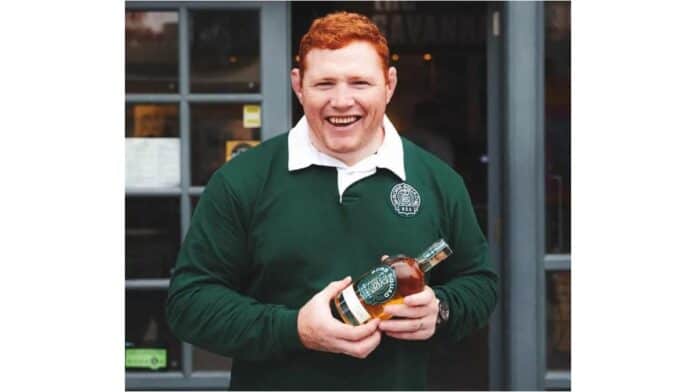
Bomb Squad Beer Expands Into The UK And Australia
International rugby legends Steven Kitshoff and Malcolm Marx reach South African rugby fans abroad
By Diane Silcock
IN three years of launching their iconic Bomb Squad Beer in South Africa, Springbok rugby legends Steven Kitshoff and Malcolm Marx have grown their brand and expanded into international markets (specifically the UK, Australia and New Zealand) bringing their products to South African rugby fans abroad. They have also diversified, exporting their Cape Town-produced brandy to the UK and introducing a ready-to-drink whiskey and ginger-ale mix (High Ball) to the local market.
In less than a year of launching in the UK, Bomb Squad Beer launched in Australia and New Zealand in June/July of 2025. But Kitshoff says that “building a brand internationally takes time, consistency, and a clear plan”.
“A key part of making the entry into the UK smoother,” says Kitshoff, “was partnering with people on the ground who really understand the UK alcohol market and its regulatory landscape. Working with experienced operators, including Scott Campbell, gave us the insight and guidance needed to navigate the space properly and avoid unnecessary missteps.”
Similarly to the UK, their entry into the Australian/New Zealand market came down to partnering with a local team who has a strong grasp of the legal framework, particularly around advertising, marketing, and compliance.
“The rules are clear and strictly enforced, so it’s important to operate within those boundaries from day one,” says Kitshoff.
Bomb Squad Beer’s lager is brewed in the UK and Australia and exported from Australia to New Zealand. This decision was largely driven by the realities of a highly competitive beer market.
“We quickly realised that if we couldn’t control our pricing, we wouldn’t be able to compete effectively. Local production allows us to reduce logistics costs, manage margins more efficiently, and ultimately offer a product that is competitively priced without compromising on quality or brand positioning.”
Brewing offshore has required some adaptation due to local ingredients and brewing conditions, resulting in all products having their own recipes and taste profiles.
“When you’re working with locally-sourced ingredients in a market like Australia,” says Kitshoff, “there will always be slight differences in flavour and texture compared to the South African brew. Water profiles, hops, malt, and even climate all play a role in the final product.”
Having said that, the core recipe, process, and quality standards are tightly managed, and they work closely with their brewing partners to ensure consistency in how the product is executed.
They have accepted that small regional nuances will exist and rather than seeing that as a drawback, they view it as part of the brand’s evolution.
In terms of the brand’s global recognition and positioning, the UK launch has been very successful according to Kitshoff. Looking at volume and revenue, he says there is still a lot of room for growth.
“We’ve always been realistic that building meaningful scale in a market like the UK takes time”.
As with their UK entry, the early focus in Australia and New Zealand (ANZ) was on getting the local South African community to buy into the brand and what it represents, which has been important in establishing initial traction and credibility in the market.
“Where ANZ differs slightly, is in its approach,” says Kitshoff. “There’s been a bigger emphasis on building the brand through events, merchandise, and a broader Bomb Squad product offering, rather than relying purely on beverage sales. This has helped create a more experiential feel around the brand and build a stronger community connection.”
Beyond beer, the rugby duo’s brandy and ready-to-drink range play an important role in broadening the brand’s presence within the beverage category.
A major focus for 2025 and 2026 has been their launch of a licensing division within South Africa with the goal being to extend the Bomb Squad brand by licensing the name into a range of products and categories through the right partnerships.
As part of that process, their external team has expanded meaningfully, bringing in specialised expertise and adding significant value to both the brand and the broader business.