













Stellenbosch solar and battery storage: Wine harvest shows why timing counts
Stellenbosch’s procurement of up to 41.9 MW of solar photovoltaic capacity and 14.8 MWh of battery storage, awarded, 22 May 2026, comes as new data from Vergenoegd Löw shows how sharply electricity demand can rise during the wine harvest.
The two developments point to a broader local energy issue: whether new solar and storage can help meet the needs of Stellenbosch’s commercial customers when demand is highest, beyond adding lower-cost power over the course of a year.
At Vergenoegd Löw, an August 2026 PV-monitoring report provided to Cape Business News earlier this month shows what that seasonal demand looks like at an individual commercial operation.
Harvest drives the electricity surge
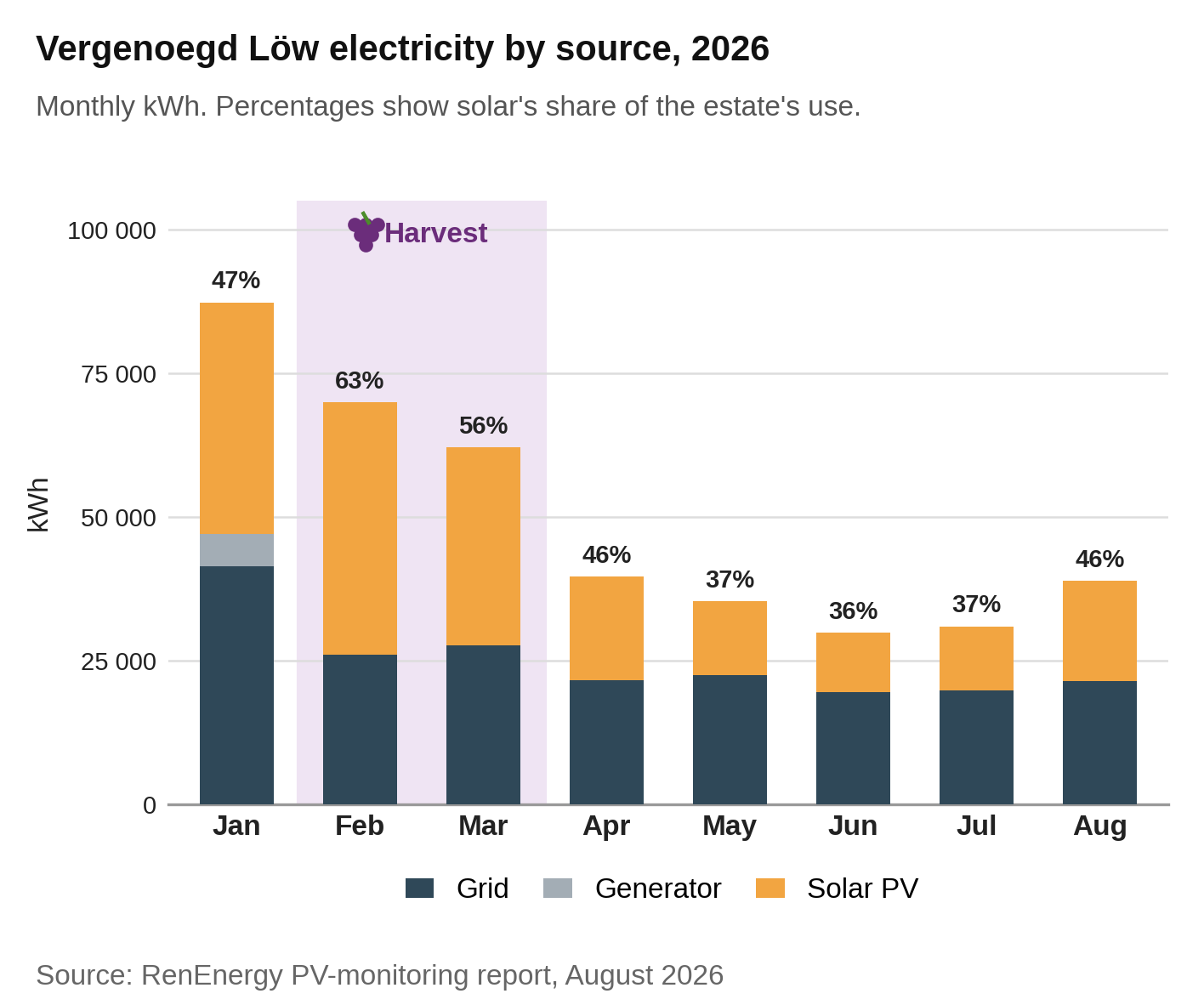
In February, the estate used more than twice as much electricity as it did in June. Its solar system generated the equivalent of 63% of that demand, so its grid electricity was only about a third higher.
Compared with June, the estate’s reported load was 40 318 kWh higher in February. Grid electricity was only 6 603 kWh higher.
Of interest is the coinciding timing of peak solar potential and the harvest season. February falls within the Cape wine harvest, when electricity demand rises sharply, while solar production is also strong.
March followed the same pattern, with solar again covering more than half of the estate’s demand. January, the estate’s heaviest month for electricity, relied more on the grid and also drew on a generator.
The estate still draws on the grid every month. What changes is the balance between on-site generation and grid electricity as demand and solar output rise and fall.
For a seasonal commercial operation, generating more electricity on site during its busiest period can limit the increase in power that has to be bought from the grid. That matters as tariffs climb. Eskom’s tariff increases this year were close to 9%, from April for its direct customers and from July for municipalities.
Almost half the load from PV
Between January and August, the estate’s solar system generated the equivalent of almost half its electricity use. The monitoring report records 183.17 tonnes of CO₂ avoided over the same period.
The harvest figures are more revealing than that average. In every other month, solar covered less than half of the estate’s demand.
For a seasonal business, that timing is the central feature of the data: the harvest months, when demand climbs, are also the months in which solar covers the largest share of it.
Stellenbosch is adding generation and storage
The municipal project is on a very different scale, but its combination of solar and battery storage points to a wider change in Stellenbosch’s electricity system.
The municipality’s tender, BSM 89/25, called for 41.9 MW of solar PV and 14.8 MWh of battery storage, procured through an independent power producer model. The RFP was issued in 2025, and the project was awarded in May 2026.
For commercial electricity users, storage can address the gap between when solar is generated and when power is needed. At Vergenoegd Löw, the harvest provides a favourable match because its demand rises during a period of strong solar generation.
The municipal buildout is also being accompanied by network investment. Stellenbosch has tendered for two 20 MVA, 66/11 kV transformers to replace three existing 7.5 MVA units at its main substation.