













Moisture control in meat processing: The hidden cost driving energy losses and food safety risks in South Africa – SCE
By Specialised Climate Engineering® (SCE)
WALK into the cold production space of almost any South African meat processing facility and the evidence is immediately visible: condensation streaking down cold walls, moisture pooling on floors at doorways, ceiling drip points above production lines.
These are not housekeeping failures. They are the predictable result of warm, humid air meeting cold infrastructure, and in facilities where Listeria monocytogenes can survive and replicate at refrigeration temperatures, they represent a food safety risk that no amount of cleaning schedule can fully mitigate.
South Africa’s meat processing sector operates under layered regulatory pressure. Ready-to-eat producers must hold HACCP certification under Regulation R908. Abattoirs and processing facilities are governed by Regulation R638. Processors targeting export markets, particularly the EU, UK, and Middle East, face additional environmental traceability requirements that are becoming more stringent, not less.
The ability to demonstrate consistent, measurable environmental control is no longer a compliance exercise. It is a commercial differentiator.
At the same time, the energy cost of managing these environments has never been higher. Eskom tariffs for direct customers rose 8.76% in 2026, with a further 9.01% municipal bulk purchaser increase effective from July. For energy-intensive operations like cold processing, where refrigeration and HVAC systems must work significantly harder in high-humidity environments, these increases are not abstract line items. They translate directly into the cost per kilogram of finished product.
Addressing the problem at source
The conventional approach to humidity in cold processing environments is reactive: run the refrigeration harder, defrost more frequently, clean more often, and accept the corrosion and condensation as unavoidable overheads.
Specialised Climate Engineering® (SCE®) takes a fundamentally different view that moisture should be managed at source before it ever reaches the cold surface.
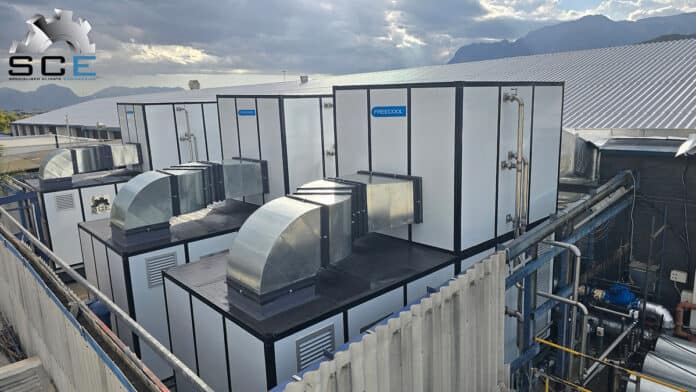
SCE®’s FREE-COOL® air handling systems are designed for exactly this operating context. Rather than simply cooling incoming air, FREECOOL® independently manages temperature, humidity, and fresh air supply, giving facility operators control over the climate in processing floors, defeathering areas, and packing halls.
Critically, FREE-COOL® is engineered to utilise a facility’s available waste heat sources as part of its conditioning process, dramatically reducing energy by up to 90%. For facilities running continuous operations, it is a structural reduction in the energy footprint of climate control.
In chilled processing and storage environments, SCE®’s DrySPACE® system takes a complementary approach. Rather than allowing warm humid air to enter cold zones and condense on surfaces, DrySPACE® actively manages humidity across processing areas, packaging zones, and cold stores, maintaining the consistently dry conditions that protect product integrity, limit pathogen risk, and reduce the accelerated corrosion that shortens the operational lifespan of processing infrastructure.
The business case is compounding
The return on investment case for active climate management in meat processing is not complicated. Lower humidity means refrigeration systems work less hard, consuming less electricity and wearing more slowly. Dry conditions mean fewer defrost cycles, longer production runs, and faster turnaround after cleaning. Consistent environmental control means auditable conditions for HACCP compliance and the documented traceability increasingly demanded by major retail supply chains and export buyers.
SCE® holds six registered patents and 14 registered trademarks across its climate engineering portfolio. These are not imported, off-the-shelf systems adapted for local conditions. They are proprietary technologies developed specifically for the thermodynamic realities of South African industrial environments.
The moisture problem in South Africa’s meat processing sector is real, measurable, and growing in consequence as energy costs rise and compliance requirements tighten. The engineering solutions exist. The question for facility operators is how long the cost of inaction remains acceptable.
For more information on SCE®’s climate engineering solutions for meat processing and cold storage environments, contact Specialised Climate Engineering® on +27 11 568 4440, info@sc-engineering.co.za or visit www.sc-engineering.co.za.