






Western Cape energy transition attracts billions in renewable investment
By Adrian Ephraim
A few years ago, the conversation in most South African boardrooms was about survival. Load-shedding was costing businesses billions in lost productivity, and the scramble for diesel generators and rooftop solar was driven by one question: how do we keep the lights on?
That question has been replaced by a more sophisticated one: how do we turn energy into a competitive advantage?
The shift is more than semantic. South Africa’s largest solar PV project reached financial close in March 2026. The first RE+ South Africa event, the global renewables industry’s flagship conference, lands in June 2026. Bid Window 7 opened with 5 200 MW of available capacity. Solar projects in the commercial and industrial segment are yielding internal rates of return of 10 to 12%, with battery energy storage systems targeting 13 to 15%. These are not emergency infrastructure numbers. These are investment-grade returns attracting institutional capital, and the businesses that understand this earliest are the ones that will carry a structural cost advantage into the next decade.
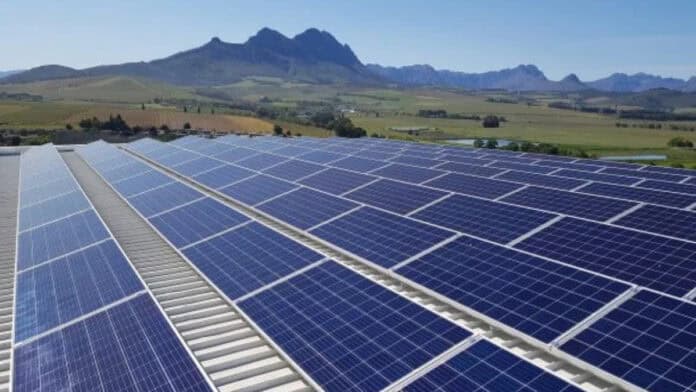
For the Western Cape, the stakes are particularly high. GreenCape’s Renewable Energy Market Intelligence Report 2026 puts the province’s investable renewable energy opportunity at R37.4 billion to 2030, across approximately 2.35 GW of new capacity. The dominant segment, large-scale wind and solar PV for private off-take through Eskom’s wheeling framework, accounts for R34.1 billion of that figure. The behind-the-meter (BTM) market, which is where most mid-sized businesses will enter, represents a further R3.3 billion.
The deal structure has changed
The most consequential shift in the market is not technological. It is financial.
Three years ago, the standard commercial solar installation was self-funded — a capital outlay justified by load-shedding fear and a rough payback calculation. That model is giving way to developer-funded Power Purchase Agreements, where a third party finances, installs, and operates the energy system on the business’s behalf. The customer simply purchases the electricity generated, at a rate negotiated below the Eskom or municipal tariff, with inflation-linked escalation locked in over 10 to 20 years.
The business case writes itself. No upfront capital. No operational risk. Immediate energy cost savings. And with Eskom’s MYPD6 tariff increases confirmed at 12.2% for 2025/26, followed by further above-inflation increases through 2028 — against an inflation rate of 3.2% in 2025 — the gap between grid tariffs and PPA-based renewable pricing is widening every year.
For a manufacturer in the Boland, a cold storage operator in Bellville, or an agri-processor in the Hex River Valley, this is a meaningful structural change. An energy cost that was a balance sheet vulnerability can be restructured as a predictable operating expense, with built-in protection against the tariff trajectory that has seen Eskom rates increase roughly tenfold against CPI since 2007.
Wheeling: the larger play
For larger energy users, wheeling adds another dimension. Rather than generating power on-site, a business can access renewable energy from a wind farm in the Overberg or a solar cluster in the Karoo, delivered through Eskom’s transmission network.
There are currently 1 267 MW of large-scale privately developed renewable projects under construction or operational in the Western Cape, almost entirely enabled by this mechanism.
The constraint is grid capacity. Eskom’s 2025 Generation Connection Capacity Assessment reported effectively zero available firm capacity for new large-scale connections in the province. NERSA’s landmark approval of 4% congestion curtailment — the first time such a mechanism has been recognised in South Africa — unlocks approximately 1 180 MW of new wind generation connections through to March 2028. That window is finite, and developers are moving to fill it. For businesses seeking wheeling arrangements, the pipeline of projects to partner with is active now. It may not be by 2029.
The decarbonisation imperative
Load-shedding may have started the conversation, but decarbonisation is sustaining it — and hardening it into commercial necessity.
South Africa draws over 82% of its electricity from fossil fuel sources. For Western Cape businesses with European customers, that is a supply chain liability. The EU’s Carbon Border Adjustment Mechanism imposes duties on carbon-intensive imports. The Corporate Sustainability Reporting Directive is already prompting European companies to request emissions disclosures from their South African suppliers. Carbon tax in South Africa is escalating toward $30 per tonne by 2030.
King V, the updated corporate governance code in effect from January 2026, extends ESG disclosure expectations to JSE-listed entities. The Climate Change Act, which commenced in March 2025, mandates greenhouse gas reporting and sectoral emissions targets. The regulatory direction is unambiguous.
For an energy-intensive business in the Western Cape, the calculus is becoming straightforward: transition now, and the investment pays for itself in tariff savings while addressing the decarbonisation pressure from trading partners. Delay, and both costs rise.
Where to start
The practical entry point for most mid-sized businesses is a PPA. The market has matured to the point where a well-structured, developer-funded solar PV system can be operational within 12 to 18 months, at a tariff below current grid rates, with no capital requirement. Regulatory simplification in October 2025 removed the professional engineer sign-off requirement for systems connected to the Eskom grid, cutting compliance costs by approximately R9 000 per installation.
Once a business understands its own energy economics, the path to wheeling, BESS, and longer-term energy strategy becomes considerably clearer.
SA’s accession to Afreximbank, which unlocks an $8 billion country programme with energy infrastructure at its core, and National Treasury’s R9 billion Credit Guarantee facility for independent transmission projects, signal that the capital ecosystem supporting the energy transition is deepening at every level — from continental finance down to commercial rooftop solar.
The curtailment window closes in March 2028. The Cape Corridor transmission upgrades that follow, scheduled for 2028 to 2031, will open the next investment wave.
The opportunity is real, the structures are available, and the entry point has never been more accessible for businesses willing to move from reactive to strategic.