











Entrepreneurs are struggling: Why mental health belongs on the balance sheet
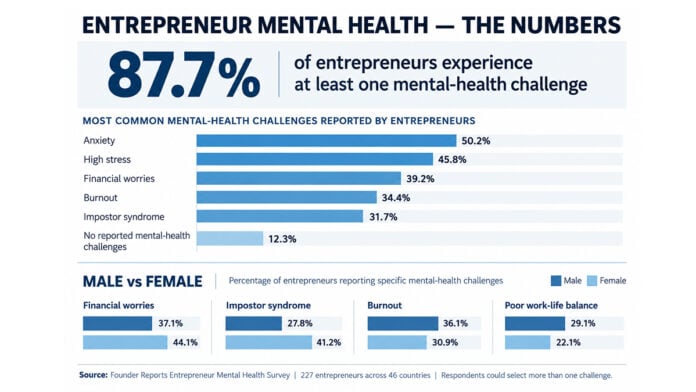
A survey of entrepreneurs found that 87.7% experience at least one mental health challenge in their daily lives. Anxiety was the most common, affecting 50.2%, followed by high stress (45.8%), financial worries (39.2%) and burnout (34.4%).
Peer-reviewed research comparing entrepreneurs with a matched group of non-entrepreneurs found that 72% of founders were affected by mental health conditions, either personally or through their immediate family.
For small businesses, when one person remains responsible for major financial, operational and staffing decisions, prolonged stress or burnout can become a vulnerability for the business.
Gugu Mjadu of Business Partners Limited says the findings reflect what South African business owners often describe in private. “SA’s entrepreneurs have built substantial companies, and many of them will tell you how hard it was. They talk about lying awake over payroll and putting their personal savings on the line.”
Insomnia and other sleep disorders affected 21.6% of the entrepreneurs surveyed, while 19.8% reported depression and 12.3% described feelings of hopelessness.
She says, “Each year, Entrepreneur of the Year® competition entrants show how closely a founder’s personal and financial life can become tied to the business.”
In many small businesses, the owner is the person employees and suppliers approach when something goes wrong. “There isn’t always a co-founder, management team or board to share difficult decisions with,” notes Mjadu.
This is why she urges founders to build support around themselves as their businesses develop. “A mentor who has faced the same decisions offers perspective.”
Separating personal and business finances and, where possible, paying the founder a regular salary creates greater clarity between the needs of the business and those of the individual behind it.
Mjadu says founder wellbeing should be viewed as part of business sustainability rather than something separate from it. “When we assess entries for the competition, we look at whether a business can sustain itself and continue creating jobs over time. In one entry, a business owner calculated that the 15 people she employed were supporting 72 family members.
A company that depends entirely on one exhausted person is fragile. Decisions about cash flow, hiring and growth are difficult enough without one person carrying every problem alone. “A business owner talking about anxiety, stress or exhaustion shouldn’t automatically be seen as someone who isn’t coping,” she says.
For entrepreneurs who recognise themselves in the statistics, Mjadu’s advice is not to wait until the pressure becomes unmanageable. “Speak to someone, whether that’s another business owner who understands the pressure, a mentor or, where needed, a mental health professional. The entrepreneurs who have come through some of the hardest periods often learnt that they didn’t have to carry everything on their own.”