











Infrared Thermometers For Electrical, Industrial, And Hvac Applications
Fluke Temperature Fundamentals
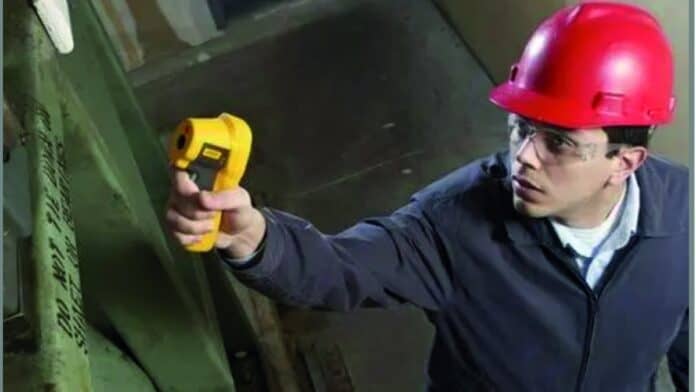
Hand-held infrared (IR) thermometers have gone from exotic to commonplace in just a few short years — and Comtest, distributor of Fluke test and measurement equipment, says that shift is transforming how maintenance teams in electrical, industrial, and HVAC environments approach troubleshooting. Portable and convenient, these tools let technicians check both product quality and process quality without ever touching the equipment being tested.
Fluke’s range of IR thermometers goes a step further on accuracy. The Fluke 62 MAX+ features two targeting lasers instead of the usual single centre-spot laser — dual rotating beams trace the outer boundary of the exact circle being measured, so users know precisely what they’re reading
Temperature measurement strategies
In general, there are three ways to use any kind of infrared, non-contact thermometer:
Measuring the temperature at a spotThis type of measurement is used to measure and track temperature at a single spot. It is useful for trending an object’s temperature or for comparing a measurement to a specification. A thermometer with high repeatability helps ensure consistency for this kind of measurement.
Comparing the temperature of two spotsThis type of measurement might be used to check the functioning of a steam trap by measuring the temperature of the inlet and outlet. No change indicates the trap has failed open. A very large change indicates that the trap has failed to close.
Scanning an object and detecting changes within a continuous area on itThis capability allows the user to find hot or cold spots on housings, panels, and structures. For example, one can check the heat sink of air-cooled transformers for cool tubes that indicate a restricted ?ow or a lack of ?ow.

Applications for infrared thermometers
Infrared thermometry can be used for process monitoring, predictive and preventive maintenance in plants, electrical applications, quality assurance, and other uses.
Infrared (IR) non-contact thermometers are ideal for moving targets and machinery, hazardous, inaccessible, or distant targets, electrical components, “big picture” evaluations of machinery or surfaces, trending records, and even protection against litigation and insurance claims. In fact, insurance companies are encouraging their customers to implement preventive infrared scanning.
IR thermometers and imagers can save time and money for contractors and customers alike, and can perform diagnostics that were previously impossible without shutting down systems.
Here are some suggestions for applications in which IR non-contact thermometers have proven useful:
Electrical maintenance
Check for heat build-up created by loose connectors. Troubleshoot problems in battery banks, power panel terminations, ballasts, switchgear, and fuse connections. Identify hot spots in the output filters on DC battery connections.
Use an IR thermometer to inspect supply power connections and circuit breakers (or fuses) for equal temperatures. An IR thermometer is effective for determining the source of the problem when a thermal overload protection device fails and the motor shuts down.
Because electrical currents generate heat, temperature monitoring is an efficient way to predict potential equipment failure.
Equipment maintenance
Check moving parts and housings in motors and gearboxes for hot spots. Temperature change can indicate developing problems in many types of equipment, from ovens and boilers to freezers. Routine temperature audits of generators and their bearings can prevent expensive repairs. Scanning bearing temperatures with an infrared thermometer allows the maintenance engineer to detect hot spots and schedule repairs or replacements before the problem leads to an equipment failure.
Building controls
Monitor HVAC/R components for quick energy audits and room balancing in a short time. An IR thermometer with a 60:1 distance-to-spot ratio makes elevated vents and returns easier to access.
For example, if a thermometer has a 10:1 distance-to-spot ratio, one can stand 10 inches away from the target and measure the temperature of a one-inch circle. At 10 feet away from the target, the measurement spot will be a one-foot circle.
An IR thermometer can quickly measure compressor head, compressor oil sump, evaporator coil and suction line, discharge line, condenser coil and liquid line, and fan motor temperatures.
Insulation on all surfaces can be scanned for leakage and losses. Higher temperatures are indicated by a shift toward white. Lower temperatures are indicated by a shift toward black.
Process/product
Monitor process lines. Check the temperature of different products on production lines. These can vary from rubber tyres to plastic, from concrete to chocolate bars.
Other useful features
A lighted display makes it easier to view results in poorly lit areas.
High-temperature alarm warnings call attention to temperatures exceeding a specified threshold. Alarms that are both audible and visible are more effective even in loud environments.