











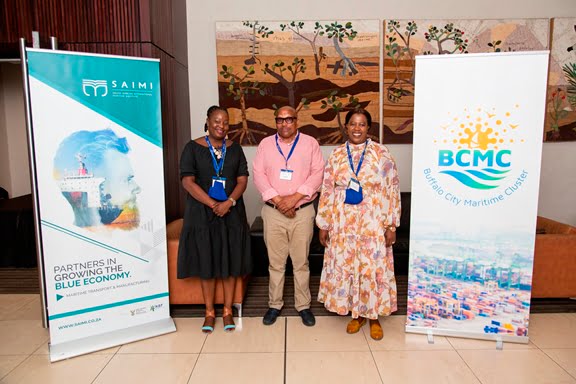
THE South African International Maritime Institute (SAIMI) in collaboration with the Buffalo City Maritime Cluster (BCMC) has hosted a first-of-its-kind Maritime Industry Engagement focused on “Cluster Strategy and conferring collaborations and support”. The hybrid event was hosted at the East London International Convention Centre recently.
Opening the event, SAIMI CEO Odwa Mtati said SAIMI was partnering with the six regional maritime clusters across South Africa to ensure a sustainable maritime sector. “The sector will only develop because we are all partners – it involves the efforts of many stakeholders interested in growing the maritime economy. Clusters succeed precisely because they have diverse interests – including those from industry, government, SMMEs, new entrants and academia,” said Mtati.
Asked how mass employment like Operation Phakisa’s potential projections of 1 million jobs by 2033 could be achieved, Oceans Economy Specialist Prof Stephen Hosking stated that “lots of small contributors add up to a big contribution. The challenge is for all parts of the model to get their prices right.”
Hosking was responsible for calculating the ocean economy’s contribution to GDP at 4.5% in a 2014 report commissioned by the President. “South Africa has a large ocean space available with an extensive natural resource inventory. The advantages of the oceans are numerous, including lower cost of transport, communication, trade and global supply chains”.
To grow jobs had always been an important part of Operation Phakisa, according to Hosking.
“Clusters can play an important role in exploiting local economies of scale. They facilitate positive local and global network development, minimise local regulatory and bureaucratic barriers, assist in penetration of global supply chains, and educate government and society on achieving local production competitiveness,” said Hosking.
The Southampton, UK-based Marine South East International CEO Dr Jonathan Williams concurred that maritime clusters stimulate investment and act as catalysts for growth.
Sharing the lessons learned in cluster modelling from the UK, Williams said the focus had successfully been on innovation and responding to the market, identifying the missing capabilities and introducing small suppliers to customers.
“We have had a particular focus on entrepreneurs and the potential for clusters to help entrepreneurs to gain traction – introducing start-ups to wider business activity. Clusters promote collaboration, which leads to funding and access to funding and diversifying businesses in high-growth sectors,” said Williams.
A Space2Waves virtual mission is also underway to build links between European SMMEs and South Africa SMMEs operating in the maritime sector.