












Skills transfer and continuous training
Key to the future competitiveness of South Africa’s Plastics Industry

AS South Africa’s plastics manufacturing sector navigates rapid technological change, sustainability demands and increasing global competition, skills development and knowledge transfer are emerging as critical priorities for the industry’s long-term competitiveness. With experienced operators, technicians, artisans and supervisors approaching retirement, manufacturers face the risk of losing decades of practical knowledge built on the factory floor.
From training challenge to strategic business risk
“The skills shortage facing the plastics industry is no longer simply a training issue. It has become a strategic competitiveness issue,” says Kirtida Bhana, Head of the Academy for Learning and Development at Plastics SA.
For many years, manufacturers have relied on highly skilled operators, setters, technicians and supervisors whose expertise has been developed through years of practical experience. As many approach retirement, businesses face the challenge of replacing critical institutional knowledge while addressing ongoing shortages of technical and production skills.
“The future success of the sector will depend on our ability to build a technically capable workforce that can support a modern, resilient and competitive manufacturing base,” Bhana stresses.
The growing demand for technical and hybrid skills
Technical roles such as machine operators, machine setters, process technicians, maintenance artisans, thermoplastic welders, quality controllers and production supervisors are becoming increasingly difficult to fill. These positions require technical knowledge, practical competence and strong problem-solving abilities.
At the same time, manufacturers require employees who combine plastics processing, materials and quality management expertise with an understanding of automation, digital technologies and sustainability.
Building skills for a circular economy
As recycling and sustainability become increasingly important, manufacturers will also need a workforce equipped to support the transition to a circular economy.
“The circular economy will require new technical competencies, including the ability to work with recycled materials, manage material variability, maintain quality standards and understand the link between processing, product performance and environmental responsibility,” says Bhana. These requirements further reinforce the need for continuous learning and ongoing workforce development throughout the plastics value chain.
Attracting the next generation
While young people continue to enter the plastics industry, numbers remain insufficient to meet future replacement and growth requirements.
Explains Bhana: “Manufacturing is often viewed as traditional factory work rather than a sector connected to advanced technology, product innovation, healthcare, infrastructure development, agriculture, automotive manufacturing and the circular economy. Changing this narrative is critical.”
The industry offers career opportunities ranging from entry-level production roles to machine setting, quality management, technical supervision, product development, recycling and entrepreneurship. Stronger career guidance, workplace exposure, learnerships, apprenticeships and mentoring will be essential to attract more young talent.
Creating career pathways
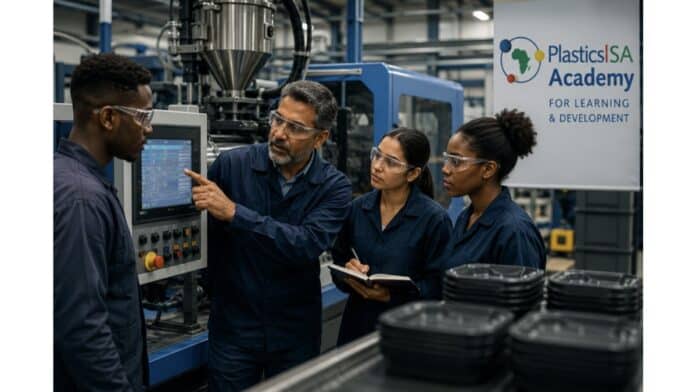
Plastics SA’s Academy for Learning and Development is strengthening occupational learning pathways for key manufacturing roles while supporting both new entrants and existing employees through structured technical training.
A key priority is developing recognised occupational qualifications that create clear career pathways, enabling employees to progress into specialist and leadership positions. Succession planning is also becoming increasingly important, with businesses identifying and preparing future setters, supervisors, trainers and technical specialists before experienced employees leave the workforce.
Investing in the Workforce of 2036
Looking ahead, Plastics SA advocates an integrated training model combining occupational qualifications, workplace learning, practical training, digital learning platforms, simulation technologies and technical coaching.
“The most important shift industry must make is to stop treating training as an annual event and start treating workforce planning as a board-level competitiveness priority,” Bhana emphasises.
Strong partnerships between employers, training providers, SETAs, schools, TVET colleges and industry bodies will be essential to build sustainable talent pipelines and improve productivity, quality, safety and competitiveness.
People remain the industry’s greatest asset
As the plastics industry continues to support packaging, infrastructure, water systems, agriculture, healthcare, automotive manufacturing and recycling, people remain central to its future success.
Automation may change jobs, but it will not eliminate the need for skilled human judgement, technical problem-solving and production leadership.
Plastics SA is encouraging manufacturers to identify critical roles, invest in structured training, create opportunities for young talent and ensure experienced employees transfer their knowledge before leaving the industry.
“The workforce that South Africa’s plastics industry will need in 2036 will not appear by accident. It must be built today through intentional planning, ongoing training, skills transfer and collaboration,” says Kirtida.
For more information visit www.plasticsinfo.co.za or contact:
Kirtida Bhana -Head: Academy for Learning and Development
Email: Kirtida.bhana@plasticssa.co.za
Cell: 082 322 0117