












Wet dust suppression systems: How to choose the right nozzle
AIRBORNE dust poses a major health and safety risk in industrial settings such as in mining, quarrying, construction, material handling, crushing, conveying, and stockpiling. This is where wet dust suppression systems play a key role in these industries in keeping dust under control.
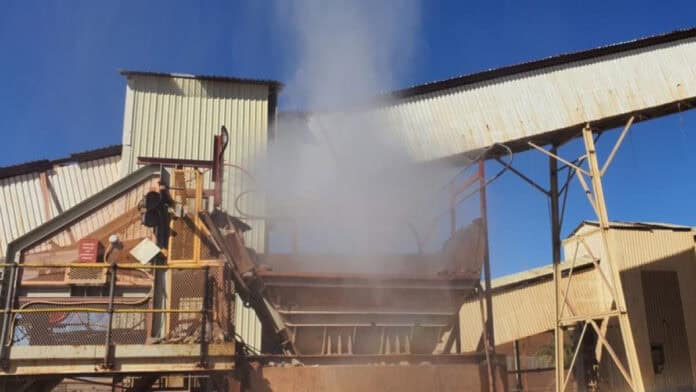
These systems work by generating fine water droplets that collide with and encapsulate dust particles. The added moisture increases the particles’ mass and weight causing them to fall to the ground or return to the material source instead of remaining suspended. This reduces health risks from respirable silica or other fine particulates, improves air quality, helps meet environmental and safety regulations, and can lower explosion risks for combustible dusts.
There are two main approaches:
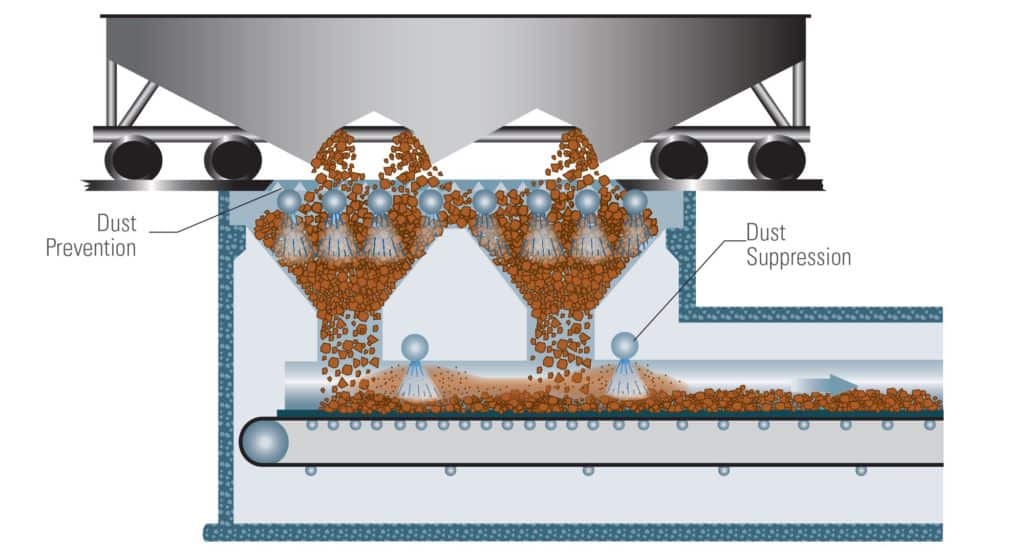
- Dust prevention: Moisture is directly applied to the material source such as ore, aggregate, or stockpiles, increasing their moisture content and preventing dust from becoming airborne. This typically uses larger droplets and higher water volumes at lower pressure.
- Airborne dust suppression: Fine mist or fog is sprayed into the air to capture particles already airborne. Smaller droplets at higher pressure and lower overall water volumes are typically used.
Water alone works well for coarser dust, but surfactants, wetting agents, foaming agents, or binders are often added to reduce surface tension, improve wetting of hydrophobic materials (such as coal), enhance agglomeration, and minimise water use while avoiding excess mud or material degradation.
Wet dust suppression systems are typically installed at dust-generation points such as transfer points, crushers, conveyors, dump hoppers, loading terminals, roads, and stockpiles, and can be fixed, mobile, or automated with sensors.
Choosing the right nozzle
Selecting the right nozzle for the application is critical, according to spray nozzle expert Monitor Engineering. Factors include dust particle size, whether the objective is prevention or airborne capture, the level of enclosure (open or enclosed), water quality, available pressure/air supply, and the need to minimise drift or over-wetting.
For airborne fine dust, droplets of roughly 10–200 µm should be targeted to effectively collide with and agglomerate particles. Smaller droplets generally perform better but are more prone to evaporation or wind drift. Air-atomizing nozzles usually produce the smallest droplets, followed by hydraulic fine-spray/hollow-cone, then flat-fan and full-cone.
A range of nozzles is available including FogJet, WhirlJet, and VeeJet styles:
- Ultra-fine respirable dust: Air-atomizing (“dry fog”) nozzles are suited to enclosed or semi-enclosed areas such as crushers, transfer points and hoppers. Using compressed air, they create very small droplets while minimising water addition and mud.
- Airborne suppression without compressed air: Hydraulic fine-spray or hollow-cone nozzles produce fine droplets efficiently and are widely used at transfer points, crushers, and ROM Bins. High-pressure systems can generate fine mist with lower water volume.
- Open-area dust prevention: Full-cone nozzles deliver medium-to-large droplets with good throw distance and coverage, making them suitable for stockpiles and road wetting.
- Targeted coverage: Flat-fan nozzles are useful for narrow or linear applications such as conveyor belts and stockpile edges.

Practical tips
- Match droplet size to dust size and use the lowest effective water volume.
- Choose large free-passage or clog-resistant designs for recycled or dirty water.
- Position nozzles close to the dust source, use adjustable fittings, and incorporate filtration.
- High-pressure misting systems are often preferred overall for efficiency and reduced peripheral issues (less material over-wetting) compared with low-pressure high-volume sprays.
There are many variables to consider when specifying a spray system for dust suppression. Correct nozzle selection, droplet size, pressure, positioning and water quality all influence system performance. A properly designed and maintained system can provide effective long-term dust control while reducing water consumption and over-wetting.
Email grant@monitorspray.co.za for a no-charge plant dust assessment.