











Coastal Park Landfill gas-to-energy plant
By Kris Van der Bijl
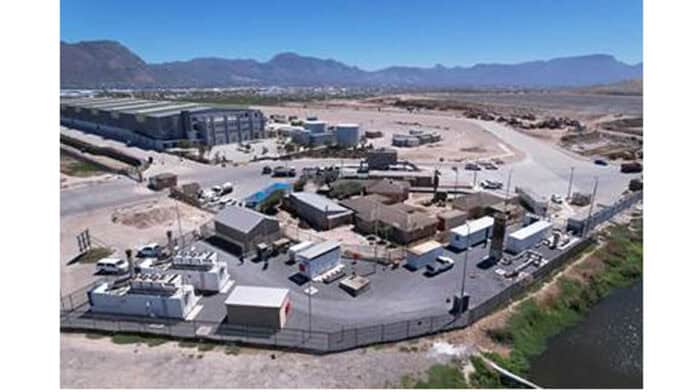
In November 2025, Cape Town commissioned its R93 million landfill gas-to-energy plant at Coastal Park Landfill in Muizenberg and the two-megawatt facility is already generating more questions than kilowatts.
The plant generates approximately 1.3 million kWh per month, of which 1.2 million kWh is fed directly into the Cape Town grid, which is enough to power more than 4 000 households, with the remainder powering the landfill’s own operations.
Perforated pipes sunk up to 30 metres into the landfill extract methane from decomposing organic waste, which is fed into on-site engines to generate electricity.
Cape Town’s plant is one of roughly eight such facilities nationally, with others in Johannesburg and eThekwini.
What distinguishes Coastal Park is what surrounds the generation figure: R36 million in carbon credit revenue already produced, and a planned R82 million expansion that is more advanced, and more complicated, than initial announcements suggested.
A revenue stream still being calibrated
Alderman Grant Twigg, Mayoral Committee Member for Urban Waste Management, is careful about how the R36 million figure is framed.
“The R36 million was for carbon credits generated over two years between January 2018 and December 2020. Since this time, it has continued to generate credits, but these must still be validated and verified under the newly established Paris Agreement Crediting Mechanism, which is being operationalised.”
The PACM is a more rigorous standard than the legacy frameworks under which the initial credits were certified.
Twigg says the City hopes to continue generating revenue “at a similar rate as 2018–2020, or even greater, as the demand for well-verified credits increases”.
This is a dynamic that could work in Cape Town’s favour as institutional buyers place more weight on verification quality.
Vissershok: the next phase
Early statements on the expansion named both Bellville South and Vissershok as candidate sites.
Twigg clarifies: Bellville South, a closed facility with declining gas yields, will not receive gas engines. Vissershok is the active focus.
“The Vissershok Landfill Site has an operational flare which has shown the potential gas yield, and a design of the landfill gas-to-energy plant has commenced,” says Twigg.
“Plant commissioning is estimated to be mid-2029 for the first phase, with further phases planned thereafter.”
That is further along than many municipal infrastructure announcements reach. Whether momentum holds through procurement is the open question.
What 2MW actually means
Asked whether a 2MW plant moves the needle on energy security or is primarily a proof of concept, Twigg reframes it.
He notes that, “The primary focus is to capture and convert the methane gas — which carries 25 to 27 times the global warming potential of CO₂ — to benign carbon dioxide and water vapour, for the protection of the surrounding communities and the environment.”
The range reflects different IPCC assessment vintages as the City’s press releases cite 25 times while Twigg’s response to CBN uses 27.
However, neither reading changes the underlying point.
On scale, Twigg is measured: “Energy security will come from a mix of different technologies. This 2MW baseload plant output sets the example for further rollout by all role players concerned.”
Coastal Park is best understood as a template, not a solution. Two megawatts does not move the needle in isolation
But a replicable pipeline across Cape Town’s active landfills is a different proposition, and Vissershok by 2029 is where that proposition will be tested.
Source: Alderman Grant Twigg, Mayoral Committee Member for Urban Waste Management
