











Mooted Port of Cape Town Wind Shields could reduce export disruptions
Transnet explores wind shields and advanced predictive modelling to curb weather-related disruptions at South Africa’s key export gateway.
By Larry Claasen
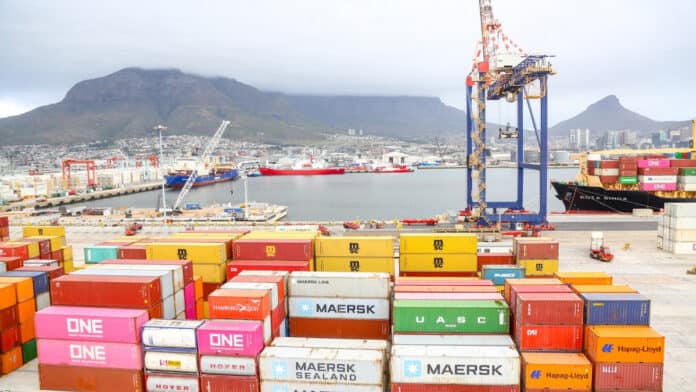
TRANSNET is considering installing wind shields to mitigate the impact of severe wind, which has seriously disrupted export operations at the Port of Cape Town.
The impact of high winds hangs over the port’s ability to export produce, despite a R3,4 billion investment in rubber-tyred gantries (RTGs) to improve the performance of the port late last year, and the acquisition of four new hybrid straddle carriers worth R96 million in July.
In February, Transnet Group CEO Michelle Philips said extreme winds, with speeds exceeding 100 km/h –120 km/h, meant the new RTGs could not be operated for 30 days between November and December. The RTGs shut down completely at wind speeds of 90 km/h or above for safety reasons.
Wind shields on the table following CSIR study
In response to questions from CBN, Transnet confirmed it is actively investigating the “feasibility of installing wind shields” to reduce the impact of severe gusts on port operations. The move follows a comprehensive study by the Council for Scientific and Industrial Research (CSIR), which identified wind mitigation as a priority.
The installations of wind shields could be an effective tool when it comes to mitigating the impact of high speed wind on the port’s operations.
The Port of Castellón in Spain, for example, completed the installation of dust-trapping screens at its South Dock, which not only reduced particles generated from handling solid bulk cargo from blowing into the surrounding areas, but also cut wind speed behind the screens by 60%.
The canvas screens at the Port of Castellón consist of a fabric specially designed for wind reduction which alters wind speed and turbulence.
Predictive modelling offers smarter decision-making
Aside from the possibility of putting in place wind shields, Transnet said it used the CSIR study to develop and improve its wind prediction model.
This provided the rail and port monopoly with more accurate forecasting to support operational decision-making and enabled more effective planning for recovery following significant wind events.
This means, the port is better able to react to lulls between severe wind sessions by having its staff ready to resume full operations when wind speeds drop off.
In August, the CSIR announced it had developed PortOps, a decision-support platform developed for the Transnet National Ports Authority (TNPA), which will assist the Port of Cape Town in improving container planning and handling operations at its container terminal.
PortOps is designed to support cargo owners, the fresh produce industry and exporters.
The CSIR said its predictive wind model, scheduled for release later this year, will also deliver more reliable wind predictions across two forecast horizons by integrating wind operability forecasts with operational decision support.
“The availability of this technology is opportune, as the Port of Cape Town continues to experience extremely strong summer winds that hinder productivity at this critical global trade gateway. While every effort is made to ensure reliability, forecasts remain subject to uncertainty,” says CSIR engineer Johan Kieviet. “Weather remains one of the biggest operational constraints, as ships cannot be loaded in high winds.”
During the pilot phase, validation results achieved up to 85% operability prediction accuracy between September 2025 and January 2026.
Climate resilience central to long-term planning
Transnet added that the impact of climate change was central to the ‘weather proofing’ of the port.
“Climate change and its impact on port operations are important considerations in TNPA’s planning for the Port of Cape Town. The work currently being undertaken with the CSIR reflects the importance of understanding evolving weather patterns and their potential impact on operations, with the aim of strengthening resilience and improving operational planning.”
In addition to its work with the CSIR, Transnet said it collaborates closely with shipping lines and logistics partners and has implemented a standardised, step-by-step recovery process to improve port operations.
“As part of its long-term planning, TNPA will continue to assess opportunities to strengthen the Port of Cape Town’s resilience to adverse weather while supporting improved operational performance,” the parastatal said.
Lost hours mount despite progress
Despite these efforts, the impact remains severe. Between November 2025 and February 2026, wind-related stoppages cost the port a total of 1,026 hours – compounding the challenges for fruit exporters in the Western Cape. Transport Minister Barbara Creecy, responding to parliamentary questions, noted that wind-related stoppage hours surged from 479 hours to 915 hours during the 2025/26 export season.
Nevertheless, Transnet reported that the Cape Town Container Terminal recorded improvements in both productivity and annual throughput volumes.
The progress was driven by new equipment and a range of operational improvement initiatives – though clearly, the weather remains the dominant variable.