









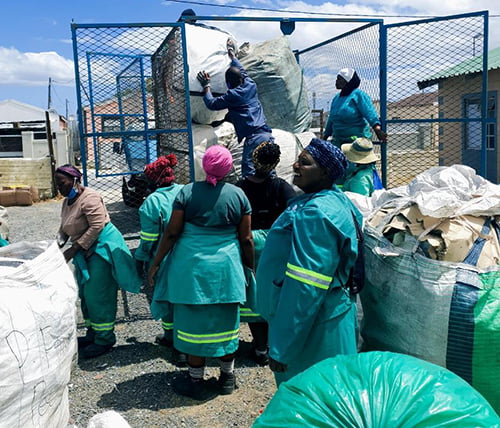
KHAYELITSHA is a poor Cape Town settlement where jobs are few and prospects are slim. But should that preclude it from entrepreneurial opportunity?
In 2019, Distell, South African producer of wines, spirits, ciders and ready-to-drinks, partnered with the Western Cape’s Department of Environmental Affairs and Development Planning, and the Cape Town City Council, to establish GreenUp.
Explains Charles Wyeth, Distell’s acting group manager of sustainability: “The goal of our private/public partnership was to start cleaning up Khayelitsha, while also generating jobs and building skills.”
The first step envisaged by GreenUp was to start clearing the area of beverage packaging and other solid waste.
Waste pickers would be equipped with protective gear and custom-built trolleys and trained in collecting, separating, and processing what they describe as “post-consumer materials” for recycling.
They would also be taught financial, business, and operational skills to negotiate with and supply their pickings to recyclable buy-back centres established for the purpose. Buy-back centres would process the materials for on-sale to packaging manufacturers for the cycle to repeat itself.
There are now 165 environmental assistants, as waste pickers are known, in Khayelitsha, supplying to seven buy-back centres in that area.
Similarly modelled enterprises have since been established with regional and local authorities in Gauteng, in Alexandria and Soweto; and in KwaZulu-Natal, in Durban and Newcastle, involving hundreds more people.
It is estimated environmental assistants each collect a daily average of 200 kg of recyclables that would otherwise find their way into landfills. The waste – glass and PET bottles, paper, metals, plastics – comes from households, taverns, streets and informal dumps.
GreenUp has worked with national government’s Expanded Public Works Programme to extend the number of environmental assistants involved.
Most recently, GreenUp has begun a collaborative glass recycling initiative in KwaZulu-Natal, the province that has been harshest hit by political unrest and climate extremes. Here it is working with Heineken. Already the initiative has cleaned up certain waste products from several informal settlements, as well as the entry and exit points of the Hluhluwe Imfolozi Game Reserve.
Applying similar training and infrastructure principles to GreenUp, Distell also runs a bottle retrieval and recycling initiative, known as the Bottle Recovery programme. Entrepreneurs who specialise in bottle recovery are registered with the company, become part of a digital network, and are assisted in skills development to establish themselves as self-sufficient businesses owners. While this project helps to lower the company’s packaging footprint even further, right now it also provides a much-needed source of supply, given the continued worldwide shortage of bottles.
Shabeer Jhetam, CEO of the Glass Recycling Company, speaking to WoSA CEO Siobhan Thompson, has been quoted as saying that glass recycling alone has produced income generation opportunities for around 50 000 waste pickers countrywide.
Currently 40% of cullet (crushed glass) goes into the manufacture of new glass bottles in South Africa.
Legislation under the Extended Producer Responsibility Scheme requires that the collection rate be increased to 64,4% by 2027. This will mean more revenue for those involved in the waste recovery programme.
Last year, GreenUp won the recycling game changer award at PETCO, South Africa’s pre-eminent environmental awards initiative, recognising excellence in re-use, recycling and waste minimisation among businesses, organisations, community groups and individuals within the South African plastics industry.