












PLASTICS SA, the umbrella body representing the South African plastics industry, has released its latest annual plastics consumption and recycling figures for the year ending December 2024. The results offer an encouraging outlook despite persistent challenges within South Africa’s waste management system and significant economic and operational pressures that had to be overcome by recyclers.
Anton Hanekom, Executive Director of Plastics SA, acknowledges that the 2025/2026 figures might paint a different story once all the data has been collected and verified.
“The purpose of Plastics SA is to collectively enhance the South African plastics industry’s long-term growth and sustainability. Each year, we compile this report by conducting in-person interviews with raw material producers and plastic reprocessors (recyclers) across the country, ensuring that the data is accurate, verified and truly reflective of what is happening on the ground,” Hanekom says.
South Africa in the global context
In global terms, South Africa’s virgin plastics consumption represents approximately 0.4% of total global plastics consumption. However, South Africa remains the largest plastics industry in Sub-Saharan Africa, supplying products to neighbouring countries both directly and indirectly through local manufacturers.
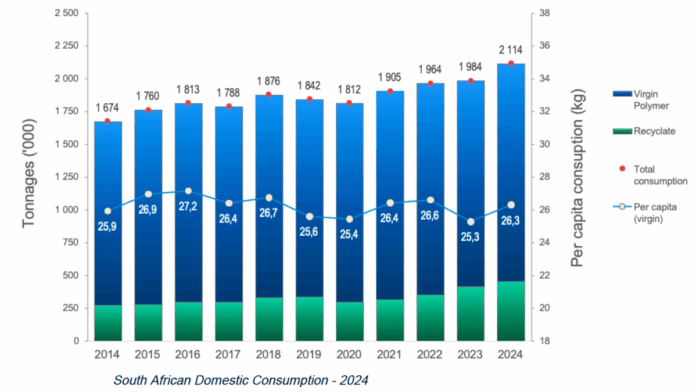
One of the most significant findings from the 2024 data is the continued shift towards recycled content. “Over the last ten years, virgin plastics consumption grew by 18%, while recyclate consumption increased by an impressive 67%. This clearly shows that local reprocessors and manufacturers are actively supporting the transition towards a more circular plastics economy,” Hanekom explains.
Where plastics are used in South Africa
The packaging sector remains the largest consumer of plastics in South Africa, accounting for 49.4% of total plastics use, across both flexible and rigid applications. This is followed by building and construction (13.2%) and agriculture (10%).
“South Africa lacks a strong non-packaging plastics sector. Engineering, industrial and customised plastic products have the potential to generate higher margins and greater economic value. Yet we continue to import large volumes of finished plastic goods – including floor, wall and ceiling coverings, sheets, films, boxes, crates and builders’ ware – that could be manufactured locally to stimulate employment and local procurement,” Hanekom notes.
Key recycling highlights for 2024
South Africa’s mechanical plastics recycling rate reached 28.4%, placing the country well above the global average and ahead of many developed economies when it comes to mechanical recycling.
Total plastics recycled increased to 471 000 tonnes in 2024, continuing a steady upward trend over the past five years.
Circular plastics content in new products rose to 22%, compared to just 16% a decade ago.
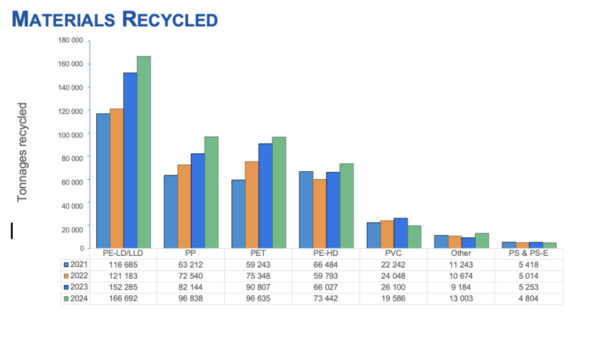
Recycling volumes increased for most polymers.
Post-industrially sourced recyclable waste increased from 17% in 2023 to 24% in 2024, reflecting greater recovery of cleaner waste directly from generators such as farms, contractors and distribution centres, rather than from landfill.
End-markets for recycled plastics are becoming increasingly diverse. Key sectors include flexible packaging (28%), clothing and footwear (12%), and agriculture (10%), alongside applications in building and construction, furniture, toys and leisure products. No single market sector relies on only one material. Instead, recycled polymers are used across a wide range of end-markets, each selected to meet specific performance and fit-for-purpose requirements.
While South Africa’s recycling performance compares favourably with many countries, it remains highly dependent on manual collection and sorting, largely driven by waste pickers and small-to-medium recycling businesses. “The recycling value chain in South Africa is long, fragmented and costly, largely due to inefficiencies in waste collection and sorting. Although this model delivers impressive recovery rates, it is also highly vulnerable,” Hanekom explains.
Furthermore, recycling growth is increasingly constrained by South Africa’s failing municipal waste management system, with an estimated 36% of households still lacking regular waste removal services.
South Africa has proven that it can recycle. What we now need is a waste management system that works, markets that value recyclate, and policies that enable long-term investment in the circular economy so that this vital industry can continue to grow,” Hanekom concludes.
The Executive Summary as well as the full Plastics SA 2024 industry data report is available at www.plasticsinfo.co.za