



Vanadium batteries: global boom boosts South Africa industry
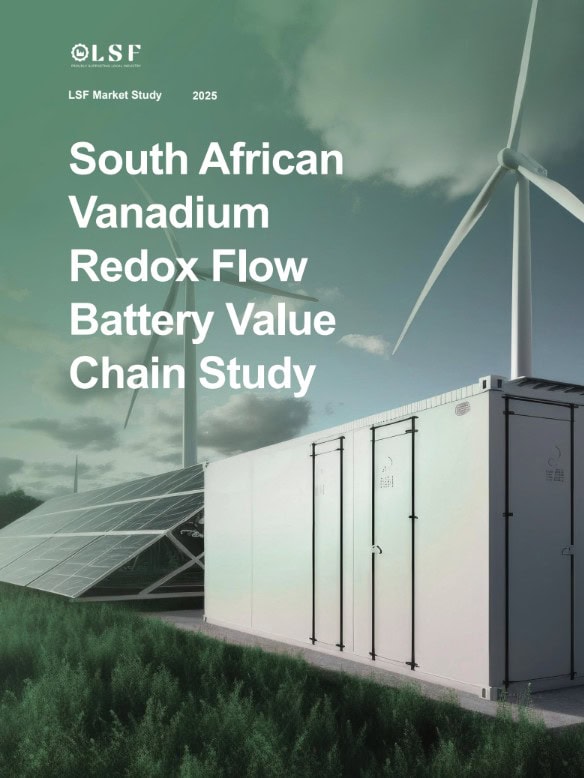
A NEW study commissioned by the Localisation Support Fund (LSF) shows that the global market for Vanadium Redox Flow Batteries (VRFBs) is set for rapid growth, driven by demand for Long Duration Energy Storage (LDES) to support renewable energy and net-zero goals.
The study, conducted by Customised Energy Solutions (CES), projects that globally installed VRFB capacity will rise tenfold from 4 GWh in 2024 to 40 GWh by 2030. While early growth will be steady, installations are expected to surge after 2027, reaching between 12 GWh and 50 GWh per year by 2030. This expansion could unlock major opportunities for South Africa to scale up its vanadium mining, refining, and downstream processing industries.
As deployment grows, vanadium’s role is expected to shift from a metallurgical input to a key enabler of the global energy transition. The share of vanadium used in VRFBs is projected to rise from 5% of total global demand in 2024 to nearly 27% by 2030, supporting a doubling in global production.
The study attributes this momentum to the convergence of global clean energy trends and the unique suitability of VRFBs for grid-scale storage. These batteries provide 10,000–20,000+ cycles, 25–30 years of operational life, and no degradation even at full capacity. They are safe, thermally stable, and use non-flammable electrolytes that can be recycled almost indefinitely — supporting circular business models and long-term cost stability. Capital costs are expected to fall from $380/kWh in 2025 to $230/kWh by 2030, matching lithium iron phosphate (LFP) batteries for applications requiring eight hours or more of storage.
“South Africa is strategically well-placed to benefit from this growth,” says Irshaad Kathrada, CEO of the LSF. “We have some of the world’s richest high-grade vanadium reserves, clear policy alignment on critical minerals, and growing demand for storage solutions that can stabilise our own energy system.”
However, the study warns that the global VRFB value chain remains highly concentrated, with 93–95% of vanadium electrolyte production currently located in China. This dominance highlights both the technological progress made there and the need for regional diversification to mitigate supply risks.
Earlier this year, South Africa’s Department of Mineral and Petroleum Resources identified vanadium as a “moderate-to-high criticality” mineral in its Critical Minerals and Metals Strategy, adding urgency to beneficiation and local manufacturing efforts.
The study stresses that policy intent alone won’t secure leadership in VRFB production. A targeted, multi-layered industrial policy is needed — one that combines mineral beneficiation with incentives for local manufacturing, domestic demand creation, and export growth. Recommended measures include Energy Storage Special Economic Zones (SEZs), tax incentives, grants, and preferential procurement for locally produced components. These align with the South African Renewable Energy Masterplan (SAREM).
“Storage solutions are central to the green industrial opportunity,” adds Kathrada. “Countries that act early will define the next wave of clean energy manufacturing. South Africa has the policy vision — now we need to make the business case work. If we hesitate, we risk losing this value to faster-moving global players.”
Deputy Minister Samantha Graham-Maré (Department of Electricity and Energy) echoed this, saying: “Vanadium beneficiation and VRFB manufacturing align squarely with our industrialisation agenda, offering a pathway to convert mineral wealth into sustainable jobs, exports, and technological capability.”
Deputy Minister Zuko Godlimpi (Department of Trade, Industry and Competition) added that localisation must go beyond import substitution: “By investing in technologies like VRFBs, we can turn our resource advantage into industrial strength, supporting manufacturing growth and decent work across the energy value chain.”
In 2020, the Industrial Development Corporation (IDC) and Bushveld Minerals co-invested in Bushveld Electrolyte Company (BELCO) in East London to develop local electrolyte production capacity of up to 8 million litres (200 MWh per year). However, financial challenges at Bushveld have delayed progress on this strategically important initiative.
With global demand for long-duration storage rising and vanadium recognised as a critical mineral, South Africa stands at a pivotal juncture. A coordinated push to develop beneficiation, refining, and manufacturing capacity could position the country as a key player in emerging global VRFB supply chains — capturing meaningful value from the global energy transition while strengthening its own industrial base.