










Cape shipping detour offers SA strategic opportunity, SAAFF | BUSA Cargo Report says
By Larry Claasen
THE rerouting of global shipping around the Cape of Good Hope as a result of the latest war in the Middle East presents a strategic opportunity for South Africa to convert passing traffic into economic value, according to the Southern African Association of Freight Forwarders
(SAAFF) | Business Unity South Africa (BUSA) Cargo Report.
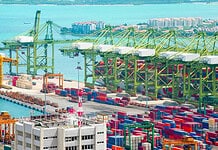
With an estimated 15% to 25% of global container capacity having shifted around the Cape, it should be an opportunity for South Africa to provide services for cargo ships.
This has not happened as local volumes have increased only marginally, indicating that South Africa remains “a transit geography rather than a service hub”, the report states, citing author Dr Jacob van Rensburg, head of strategic research & industry intelligence, SAAFF.
The strategic opportunity lies in converting passing traffic into economic value, “especially through bunkering and maritime services – but this is contingent on system wide reliability”, van Rensburg explains. “Geography provides exposure, but performance will determine conversion.”
South Africa failed to fully grasp a similar opportunity when the Suez Canal was blocked from 23 to 29 March 2021 when the Ever Given, a container ship that had run aground, disrupted the global supply chain.
Converting this latest opportunity is also made difficult by the lack of investment in South Africa’s port infrastructure. This is currently being addressed as President Cyril Ramaphosa recently said that up to R250 billion would be invested in ports and logistics modernisation.
“The Port of Durban is being expanded to handle higher container volumes and improve efficiency, with similar upgrades in Cape Town and Ngqura,” he said at the Sixth South Africa Investment Conference.
Pressure at the pump
The report also notes that the current global disruption is being transmitted primarily through energy, with rapid pass-through into domestic logistics costs.
In road freight for example, fuel constitutes up to 30% to 50% of total costs, placing immediate pressure on inflation, transport margins, and trade competitiveness.
The Strait of Hormuz disruption, which has seen Iran prevent the passage of certain nations through it, represents an energy-driven systemic trade shock, affecting approximately 25% of seaborne oil flows. Resulting oil price spikes – potentially exceeding $150 to $200 per barrel – are transmitting into higher transport costs, inflation, and weaker trade.
Second-order risks include fertiliser supply and food security, while global trade growth has been revised to roughly 1,5% to 2,5%.
Shipping networks have adjusted by redeployment capacity rather than withdrawing it. This move avoided a system-wide shock but created localised congestion.
Though freight rates are up modestly at 4,9% and geographically concentrated, there are rising concerns over opaque, non-cost-reflective war-risk surcharges, signalling “pricing power, risk transfer, and declining trust in carriers”.
In global air cargo, connectivity has been severely disrupted following the escalation in the Middle East, with approximately 73% of seat capacity withdrawn within ten days.
Despite strong February demand (cargo ton-kilometres up 11,2%) and capacity growth (up 8,5%), high-frequency data now indicate tightening conditions.
Volumes are declining 1% week-on-week and 6% year-on-year. At the same time, spot rates are rising 7% week-on-week and 26% year-on-year. This is driven by significant capacity shortfalls in the Middle East, which are down 37% year-on-year.