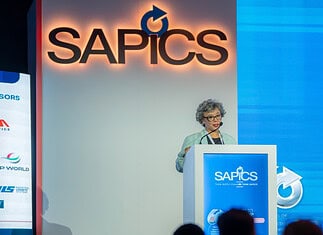








Power utilities increasing their borrowings to cover costs, may put these institutions on “a very dangerous slippery slope”, said senior energy specialist at the World Bank, Chris Trimble when he addressed delegates at the recent Africa Utility Week Conference in Cape Town.
He presented findings of a World Bank report on ways to make power utilities more financially viable.
Responding to a question on Eskom’s borrowing, Trimble who seemingly didn’t want to be drawn on the issue said it is always better for power utilities to be self-sufficient and not depend on government subsidies to avoid becoming trapped in a vicious spiral when debt gets out of control.
Trimble’s warning follows media reports on Eskom’s interim results published in November last year which showed increased costs and declining profits. This was followed by a credit downgrading by ratings agency Standard & Poor with significant implications for Eskom’s borrowing ability. The Mail & Guardian last year reported Eskom’s debt obligations then already stood at R317 billion.
Trimble’s statements followed an undertaking to journalists by Eskom chair Dr. Ben Ngubane that Brian Molefe after his reinstatement will make electricity more affordable.
Ngubane made it clear it is all systems go for Eskom after the board’s latest decision.
“Our objective is to lower the cost of electricity in the country by paying back the government guarantees, generating enough revenue, creating savings through efficiencies like the design to cost programme,” he said.
In an earlier statement and interview on the report, the World Bank singled South Africa out as the most developed in terms of its electricity sector in Sub Saharan Africa and Eskom as one of the best performing utilities in the region.
Meanwhile Trimble in his presentation shared the findings and recommendations of the World Bank report on how power utilities in African countries can become more financially viable. Data of power utilities in 39 African countries were used. It showed many of these African countries are unable to cover their operating expenditure leading to deficits.
These findings highlight a significant revenue gap in most African countries with only two exceptions – Uganda and the Seychelles who recover all their costs. “It’s quite a bleak picture,” Trimble admitted.
With many countries not recovering operating costs sufficiently, it may hamper maintenance of infrastructure which can ultimately also affect the reliability of power provision, Trimble warned.
Trimble shared pointers with delegates on how power utilities can recover costs for electricity supply and make it affordable. These include steps as starting with eradicating operational inefficiencies and gradually increasing tariffs in small amounts.
The report shows very few utilities are financially viable with only 19 to half of the countries surveyed able to recover operating costs.
He also pointed out that operating costs in some countries like Liberia is still “unbelievably high”. The cost drivers for this, Trimble told delegates, include the source of energy that is critical and geography that is important as landlocked countries’ costs are usually higher.
Trimble also singled out under-pricing as among the dominant factors in power utilities’ financial viability.
Over 7 000 decision makers from over 80 countries attended the three day conference where the latest developments, challenges and opportunities in the power and water sectors came under the spotlight.
Over 300 experts discussed innovative solutions to the continent’s energy and water challenges and the exciting opportunities for utilities and industry players.