














The next chapter in the ongoing narrative around additives, with WearCheck – the specialist condition monitoring company – centres around demulsifiers.
| What are they? | Organic soaps and soaps of fatty acids, organic polymers. |
| What do they do? | Encourage water to separate out of oil. |
| How do they do it? | Break down the oil-water interface so that water droplets can coalesce and sink. |
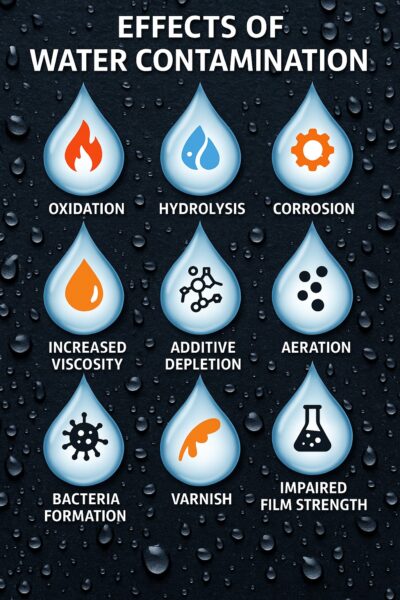
The effects of water on oil and the system being lubricated are insidious. Water is one of the most destructive contaminants in almost all lubricants and applications. It attacks the base oil, the additives blended into the oil, and the mechanical system being lubricated.
Water can hasten the oxidation of a lubricant and ultimately shorten its service life. It encourages the build-up of sludge and varnish, and causes metal parts to rust and corrode.
But wait, there’s more! Water can also deplete the lubricant’s film strength, making components more vulnerable to wear, while stripping the lubricant’s additives, which impacts its performance and diminishes its ability to protect metal surfaces.
Many oils separate well enough from water on their own, but some base oils and additives are prone to forming a stable emulsion when water is present, and, as such, require the addition of a demulsifier additive.
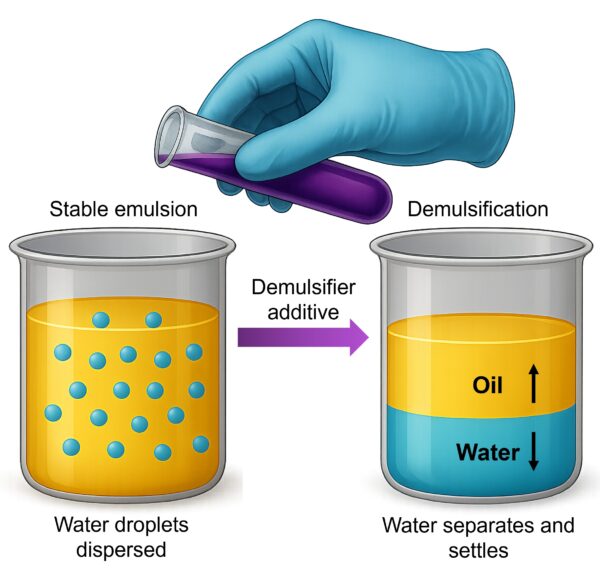
Demulsifier additives prevent the formation of a stable oil-water mixture or an emulsion by changing the interfacial tension of the oil, so that water will coalesce and separate more readily from the oil.
This is an important characteristic for lubricants exposed to steam or water, so that free water can settle out and be drained off easily at a reservoir. Most engine, gear, hydraulic and turbine lubricants are formulated with this additive.
Just to be clear, demulsifer additives don’t stop the ingress of water into the oil but instead allow the water to separate out more readily, and in so doing, limit its destructive potential.
An interesting fact about this lesser-known additive – the chemical compounds used to create demulsifier additives are actually the same group of chemicals used to form stable oil-water emulsions in oil-water-based metal-working fluids and fire-resistant fluids, but in much lower quantities. That’s right folks, the same stuff that demulsifies can also emulsify if large enough quantities are added.
Please visit www.wearcheck.co.za or email marketing@wearcheck.co.za for more information.