












How rotary atomisers work
Keller Application
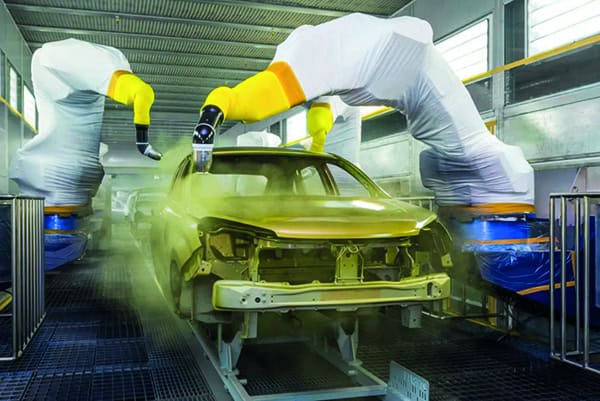
Painting the bodywork is an integral component of vehicle Manufacturing. During the early period of car manufacturing, high-gloss bodywork finishes were associated with high costs and time expenditures. The first electrostatic rotary atomisers were developed in the 1980s and ’90s.
Rotary atomisers (also known as paint robots) are advantageous because they use material economically. Thanks to the high-voltage paint charge, 90 percent of the paint is applied directly onto the bodywork and is no longer wasted. Rotary atomisers of this kind merely require a rotating disc.
The paint to be atomised forms a film on the disc that becomes increasingly thinner towards the edges and dissolves into droplets whose size is controlled via the speed of rotation. A nozzle ring is required around the atomiser to direct and shape the paint jet. The atomiser can, therefore, be operated in any position and used for external and internal finishings. This type of rotary atomiser is, therefore, ideal for the car industry.
Intrinsically safe pressure transmitter for the spray head
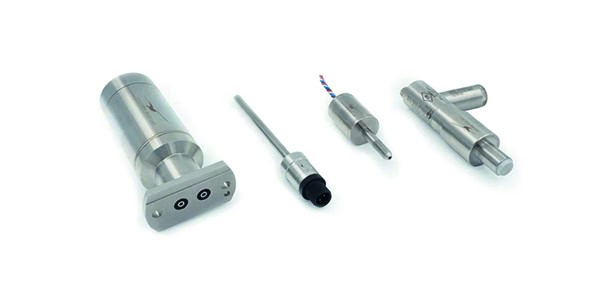
KELLER supplied intrinsically safe pressure transmitters and intrinsically safe temperature sensors to a client who produces paint robots for the car industry.
How are they intrinsically safe? Even though non-flammable water-based paint is usually used on bodywork parts, the mist created during atomisation can take on a flammable state. Although hazards only occur in the rarest case during paint spraying, rotary atomisers must be equipped with explosion-proof technology.
Some pressure transmitters are fitted in the robot’s spray head. They measure the spray pressure in the paint spray system and detect quick pressure changes caused, for example, by placing hoses. The pressure transmitters are located in a high-voltage field and communicate with the robot control mechanism via a fibre-optic cable. In contrast, additional pressure transmitters and temperature sensors monitor the dosing system and the pumps of the axes. These pressure transmitters communicate with the control system through conventional analogue via copper conductors.
KELLER’s equipment manufacturing team develops automation solutions that are tailor-made for the requirements of its production department and that meet its high standards of quality and precision. This has allowed KELLER to improve its products continuously and process stability and efficiency over the last 50 years.
Contact INSTROTECH, local representative, for more information on KELLER’s ROTARY ATOMISERS FOR EFFICIENT PAINT SPRAYING on 010 595 1831 or sales@instrotech.co.za