












Unlocking the smart factory
SOUTH Africa’s manufacturing sector is at a turning point. While Industry 4.0 technologies are reshaping global production, many local manufacturers still rely on legacy equipment and traditional processes. This limits efficiency, increases operational costs, and makes it harder to compete with digitally integrated factories worldwide.
ElectroMechanica (EM) recognises that transitioning to smart automation isn’t just about adopting new technology; it’s about solving real challenges. Labour shortages, rising costs, and downtime due to outdated machinery make digital transformation essential for long-term competitiveness.
Together with Delta Electronics, EM brings over 40 years of industry expertise to help manufacturers integrate scalable automation solutions tailored to South Africa’s industrial landscape.
While automation technologies could displace around 576,000 jobs in the sector by 2030, they also present significant opportunities. With the right approach, productivity-driven growth could generate up to 4.5 million new jobs across the country.
Realising these benefits depends on a structured transition. Manufacturers must prioritise upskilling and infrastructure modernisation to unlock automation’s full potential. A skilled workforce is key to maximising efficiency. However, meeting future demand will require significant investment in workforce development, as South Africa is projected to need 1.7 million additional skilled professionals by 2030.
EM focuses on practical solutions to close skill gaps, reduce risk, and simplify the adoption of automation technologies. By combining intelligent automation with targeted workforce development, manufacturers can build a more resilient, future-ready industry.
Labour shortages and skills gaps remain significant barriers to manufacturing efficiency. Many production lines struggle with shortages as repetitive manual tasks lead to fatigue, lower productivity, and increased safety risks. At the same time, the transition to Industry 4.0 requires a highly skilled workforce, yet existing training initiatives fall short of meeting demand. Without strategic upskilling initiatives, manufacturers risk falling behind in an increasingly digitalised industry.
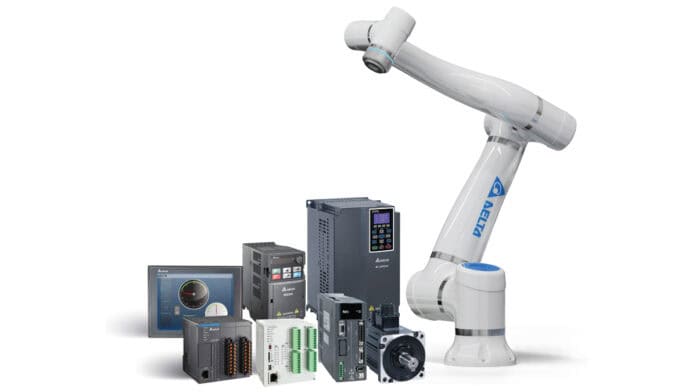
In a common scenario, production teams grappling with persistent labour shortages and safety risks could substantially benefit from integrating Delta’s D-Bot cobots, a solution which enables seamless human-robot interaction.
EM supports manufacturers beyond supplying automation hardware and software by providing comprehensive training programmes that equip workers with the skills to confidently operate and integrate smart technologies into their workflows. Combining intelligent automation with structured upskilling improves efficiency, reduces absenteeism, and fosters a workforce that sees automation as a tool for safer, more productive operations, not as a replacement for human expertise.
By integrating predictive analytics into everyday operations, businesses gain greater control over maintenance planning, turning automation investments into data-driven, economically-sound decisions.
For many South African manufacturers, upgrading legacy systems remains a challenge. The cost and complexity of replacing outdated machines often deter investment, particularly for smaller operations. Yet, as industrial automation advances, the need for seamless integration between old and new technologies has never been greater.
With a scalable, modular design, Delta’s controllers enable manufacturers to upgrade at their own pace, minimising disruption and controlling costs.
Infrastructure limitations remain a major obstacle to digital transformation in manufacturing. Many factories hesitate to upgrade, concerned about high costs and operational disruptions. However, with the right approach, manufacturers can enhance visibility and control without overhauling existing systems.
Secure remote monitoring solutions through advanced SCADA systems are designed for seamless integration. VTScada enables real-time monitoring and control while maintaining robust cybersecurity protections.
As manufacturing becomes more connected, cybersecurity risks are becoming an increasingly urgent concern. Industrial control systems and factory networks are frequent targets of cyberattacks, leading to production losses, data breaches, and reputational damage. Manufacturers, particularly those reliant on legacy systems, may not have the internal expertise or infrastructure needed to address these evolving threats.
The transformation to smart manufacturing is strategic. Automation is about intelligently and incrementally using technology to achieve meaningful growth. Digitalisation and automation offer substantial opportunities, provided manufacturers proactively manage workforce transitions, skills development, and integration complexities.
The future of South African manufacturing depends not merely on technology adoption but on strategic decisions and investments made today. Industry 4.0 is no longer distant. The real question is, are businesses ready to lead or risk being left behind?