











Boegoebaai Port decision expected in 2027 as R13.8 billion Northern Cape megaproject advances
Infrastructure South Africa targets early 2027 for a winning bidder as the Northern Cape megaproject promises 13,770 jobs and a 3,6% GDP boost by 2050.
By Larry Claasen
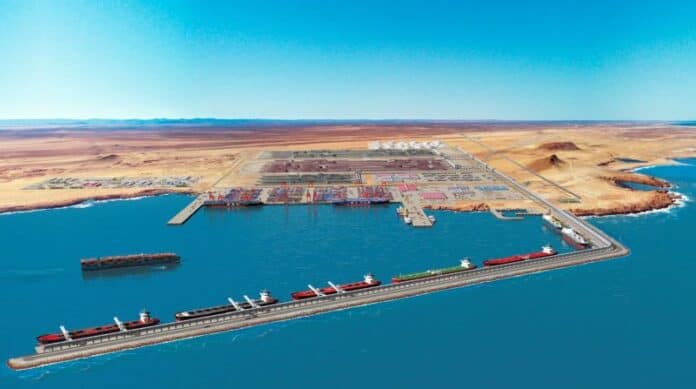
INFRASTRUCTURE South Africa (ISA) says an announcement on who will win the bid to build a deep-water R13,8 billion port at Boegoebaai in the Northern Cape will likely be made in the first half of 2027.
The port, comprising a dry bulk export berth and a break-bulk berth, along with the adjacent Namakwa Special Economic Zone (SEZ) and a new 550 km rail line, is expected to become a hub for the country’s Green Hydrogen programme.
Green Hydrogen is the creation of hydrogen by using renewable electricity to electrolyse water. It is seen by many developing countries, such as South Africa and Namibia, as a huge opportunity to develop their economies.
The idea behind the Boegoebaai project, which is about 20 km from the Namibian border, is to create and export Green Hydrogen, which could add 3.6% to GDP by 2050 and create 370,000 jobs, according to the government’s Green Hydrogen Commercialisation Strategy.
Though the government has long envisaged a port at Boegoebaai, progress has been slow.
“Boegoebaai has been a dream of various successive governments in South Africa,” said ISA CEO Mameetse Masemola.
The slow pace is evident: Transnet announced a shortlist in July 2023 but only issued a tender for transaction advisory services for the project in November 2025. The winner of the nine-month advisory contract would advise on legal, commercial, financial, and technical transaction services to enable the successful procurement and commercialisation of the port’s development.
Masemola said the shortlisted candidates to develop the port — Boegoebaai Port & Rail Consortium, Boegoebaai Development Consortium, and Project Elephant Consortium — were being assessed, and a winner would likely be announced in early 2027 if everything went to plan.
“If there are no external shocks to the process, we believe that in less than a year, Transnet will be at the position where it can announce who the successful bidder is,” said Masemola.
Setting up to be invested in
The Boegoebaai project is one of 20 major infrastructure projects worth R286 billion that the ISA is preparing for investment.
The ISA was created in response to the high failure rate of infrastructure projects. It takes over project preparation at an early stage by acting as a single point of entry for infrastructure planning, management, and delivery.
After preparation, projects are handed over to others for financial structuring and implementation, said Masemola.
“And then we hand over these projects to National Treasury, to other Development Finance Institutions (DFIs), the Development Bank of Southern Africa (DBSA), the Industrial Development Corporation (IDC) and others, who then do the financial structuring and look to get these projects to be fully funded. And then implementation takes place.”
Complex and time consuming
Preparing these projects to be investment-ready is a complex and time-consuming process, but if it is not done right, it heightens the chance of failure.
“It’s a heavy-lifting exercise, and takes quite a long time. Some projects, we can prepare them for up to 18 months to get it right, because we know that if they are not properly prepared and packaged, 80% of them fail,” Masemola said.
The ISA’s projects span a wide range of sectors and clients. “So these projects range from wastewater treatment works projects to the City of Ekurhuleni, City of Tshwane, to special economic zones, to health infrastructure projects, and Transnet projects, railway projects.”
Masemola said six of these are earmarked for submission to the Budget Facility for Infrastructure (BFI) to unlock fiscal allocations.
“So we will be taking these projects — six of these projects are earmarked for what they call National Treasury’s BFI. It is a platform where government-led projects are submitted for appraisal to unlock additional fiscal allocation for these projects.”
ISA’s success is measured by National Treasury approvals and the quantum of funding unlocked. “So our measure of success will be the extent to which those projects are approved by the National Treasury, and the quantum of funding that gets to be unlocked for those projects. So that’s our measure of success.”
A big pay off
The economic impact of getting these projects off the ground is immense. Just the construction phase will see the creation of about 3,000 direct jobs and almost 14,000 indirect jobs. Once the port is completed, 400 permanent jobs will be needed to manage it, and over time, an estimated 13,770 jobs could be created in the region.
This kind of economic boost is sorely needed not only for the country but especially for the Northern Cape, which, according to a presentation its provincial government made to Parliament a year ago, has sunk further into poverty.
This can be seen in the number of individuals living below the upper poverty line increasing by 338,4%, from 611,000 in 2014 to 817,000 in 2024.