









More new equipment for the Cape Town Container Terminal
The Cape Town Container Terminal (CTCT) took delivery of another four new hybrid straddle carriers last week, in a R96 million investment which forms part of Transnet Port Terminal’s comprehensive equipment replacement programme to ensure full recovery of terminal operations. Straddle carriers are specialised cargo handling equipment that lift, move and stack shipping containers.
The hybrid straddle carrier technology is the first deployment in Southern Africa with the straddle carriers arriving fully assembled. The equipment will require in-cab computers with software that provides operators with real-time instructions and cargo tracking before hand over to operations in July. The terminal is also completing its operator conversion training to ensure employees are able to maximise the capacity of the modern equipment which operates using both diesel and electric power.
Managing Executive at the Cape Terminals Earle Peters said, “The diesel engine charges onboard batteries and once fully charged, the units switch to electric mode. This technology reduces fuel consumption, lowers emissions and decreases noise levels, while maintaining the operational performance required in a busy container terminal environment”. He added that the investment will provide more equipment to support daily operations across the terminal, which gives operational teams greater flexibility in managing container movements and supporting customer requirements.
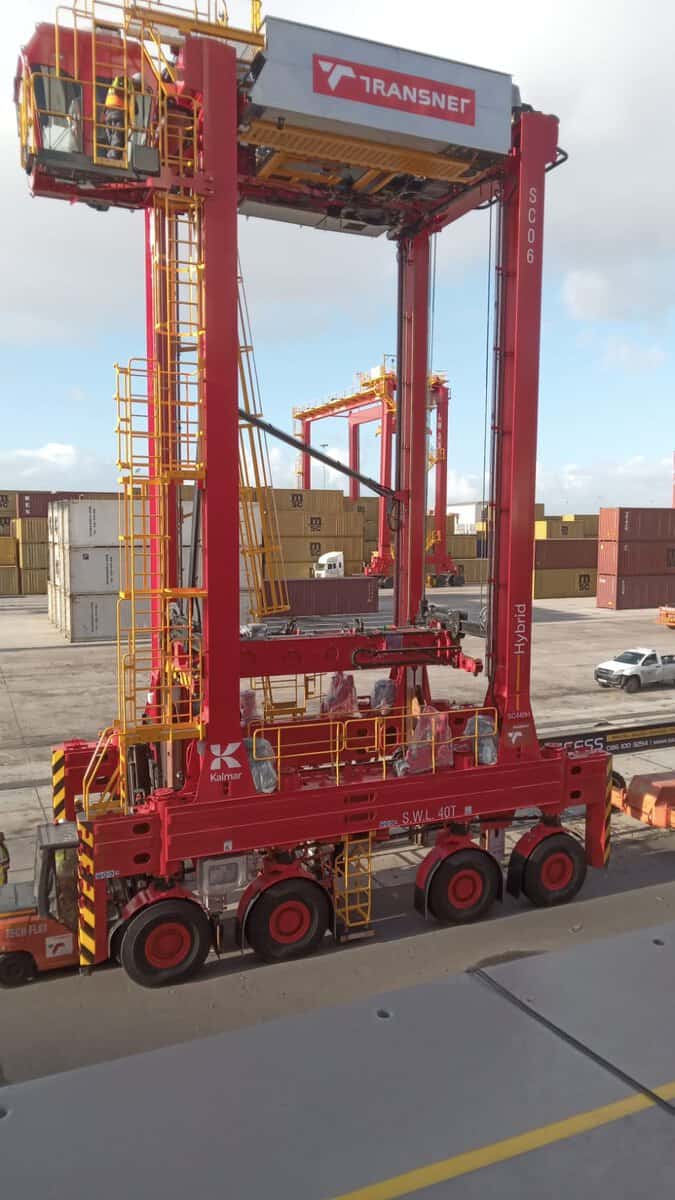
Predominantly a rubber-tyred gantry crane (RTG) operation, the Cape Town Container Terminal is transitioning into a hybrid operation that uses both straddles and RTGs to accommodate yard capacity and fulfil operational demand. The Cape Town Container Terminal has improved on productivity and annual volumes as a result of the injection of new equipment.
TPT has invested a total of R9 billion over the last three years on new cargo handling equipment across its 15 terminals nationally. Major capital investments in the current 2026/2027 financial year include straddle carriers and empty container handlers for the Cape Town and Port Elizabeth container terminals; rubber-tyred gantry cranes for the Durban Container Terminal Pier 1; reach stackers for multipurpose terminals; and haulers for the Richards Bay operations.
Despite wind, fog and vessel ranging delays accounting for 74.15 days of weather disruption throughout the 12-month period ended in March 2026, the Cape Town Container Terminal has also improved on productivity and annual volumes as a result of the injection of new equipment.