












Namibia green hydrogen hub powers clean transport and industry
By Adrian Ephraim
NAMIBIA has taken a significant step towards establishing itself as a major player in the global green hydrogen economy, with the commissioning of what Siemens describes as Africa’s first fully integrated green hydrogen facility.
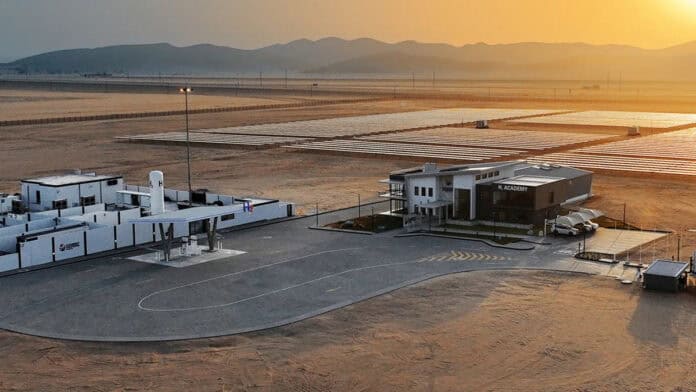
Located in Walvis Bay, the CMB.TECH facility combines solar generation, green hydrogen production and battery storage in a single off-grid operation, providing a working model for how renewable energy can be deployed at industrial scale.
The project is significant for Namibia’s ambitions to develop a hydrogen economy while reducing the carbon intensity of its transport, logistics and industrial sectors.
“Africa’s first fully integrated green hydrogen facility demonstrates that large-scale clean energy production is not a future ambition, but a present-day reality,” said Sabine Dall’Omo, CEO of Siemens Sub-Saharan Africa.
The facility currently comprises a 5MWp solar park spanning 6.5 hectares, a 5MW Proton Exchange Membrane electrolyser and a 5.9MWh battery energy storage system.
The solar park’s electricity powers the electrolyser, which uses electricity to split water into hydrogen and oxygen. The hydrogen is then available for industrial and transport applications without relying on grid electricity or fossil-fuel-based power.
CMB.TECH is using the hydrogen itself, making the company the facility’s first customer and providing an immediate source of demand for the fuel.
This addresses one of the key challenges facing emerging green hydrogen projects: securing commercial offtake for the hydrogen produced.
“Many green hydrogen projects are stalling because, while they invest heavily in solar energy and green hydrogen production, there is often no commercial offtake agreement in place to secure demand for the hydrogen produced,” Dall’Omo said.
From trucks to ships
The initial applications include dual-fuel trucks, generators and Namibia’s first hydrogen-powered freight locomotive.
The longer-term ambition is considerably larger. CMB.TECH plans to integrate the facility with port infrastructure and eventually produce ammonia from green hydrogen for use as a marine fuel.
The process involves combining hydrogen with nitrogen extracted from the air to produce ammonia, which can then be liquefied and potentially used to refuel ships.
That could position Walvis Bay as a future hub for lower-carbon maritime transport, while strengthening Namibia’s role in regional and international renewable energy supply chains.
Wiebke Polomka, senior manager for Southern Africa at Afrika-Verein der deutschen Wirtschaft, said the project demonstrated how hydrogen could help decarbonise transport and logistics.
“From supporting local mobility solutions to enabling future maritime refuelling infrastructure, it provides a tangible pathway toward lower-carbon industrial and shipping ecosystems,” she said.
Siemens is providing the electrical, automation and safety systems supporting the facility, with the technology designed to allow the different components to operate as a single integrated system.
Building local skills
The project is also being positioned as a skills-development platform rather than simply an energy-generation facility.
CMB.TECH has established a Hydrogen Academy at the site to train drivers, technicians and scientists. Of the facility’s 25 employees, 24 are Namibian and have received training through the academy.
The company is also working with local universities and institutions, including the Namibia Institute for Mining Technology, to develop engineering and technical skills required to support a domestic hydrogen industry.
“The project is training a new generation of engineers and technicians,” said Johannes Shimbilinga, municipal mayor of Walvis Bay. “This creates a sustainable pipeline of local expertise, positioning Namibia as an exporter of not just green molecules, but also the technical knowledge required to operate and maintain a hydrogen economy.”
The facility is effectively being used as a “Living Lab” for Namibia’s emerging hydrogen economy, according to Roy Campe, chief technology officer at CMB.TECH.
Scaling from 5MW to 500MW
The current installation is intended to be the starting point rather than the end state.
Campe said CMB.TECH plans to increase the solar capacity from the current 5MWp to 250MW and eventually 500MW.
The existing solar park comprises around 7 000 panels, with the company envisaging a future facility containing millions of panels.
“We want to turn Namibia into a global energy hub and export energy to Europe and the rest of the world,” Campe said.
Namibia’s exceptionally high solar resource is central to the ambition. The country experiences around 300 sunny days a year, providing significant potential for large-scale renewable generation.
For Namibia, the opportunity extends beyond replacing fossil fuels in domestic applications. Green hydrogen and its derivatives could become an export industry, allowing the country to convert its abundant renewable resources into energy products for international markets.
The Walvis Bay project therefore offers an early test of whether Africa can move beyond plans and announcements around green hydrogen and develop commercially operating infrastructure.
