













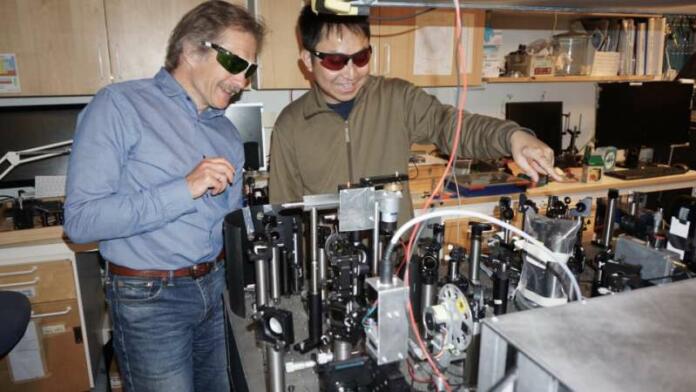
A research team led by Lund University in Sweden has shown how solar power can convert carbon dioxide into fuel, by using advanced materials and ultra-fast laser spectroscopy. The breakthrough could be an important piece of the puzzle in reducing the levels of greenhouse gases in the atmosphere in the future. The study is published in Nature Communications.
The sunlight that hits Earth during one hour corresponds roughly to humanity’s total energy consumption for an entire year. Our global carbon dioxide emissions are also increasing. Using the sun’s energy to capture greenhouse gases and converting it into fuel or another useful chemical, is a research focus for many today. However, there is still no satisfactory solution, but an international research team has now revealed a possible way forward.
“The study uses a combination of materials that absorb sunlight and use its energy to convert carbon dioxide. With the help of ultra-fast laser spectroscopy, we have mapped exactly what happens in that process,” says Tönu Pullerits, chemistry researcher at Lund University.
The researchers have studied a porous organic material called COF—covalent organic framework. The material is known for absorbing sunlight very efficiently. By adding a so-called catalytic complex to COF, they succeeded, without any additional energy, in converting carbon dioxide to carbon monoxide.
“The conversion to carbon monoxide requires two electrons. When we discovered that photons with blue light create long-lived electrons with high energy levels, we could simply charge COF with electrons and complete a reaction,” says Kaibo Zheng, chemistry researcher at Lund University.
How can these results be useful? Tönu Pullerits and Kaibo Zheng hope that in the future the discovery can be used to develop larger units that can be used on a global level to, with the help of the sun, absorb carbon dioxide from the atmosphere and convert it into fuel or chemicals. That could be one of many solutions to overcome the climate crisis we are facing.
“We have completed two initial steps with two electrons. Before we can start thinking about a carbon dioxide converter, many more steps need to be taken, and probably even our first two must be refined. But we have identified a very promising direction to take,” concludes Tönu Pullerits.
