



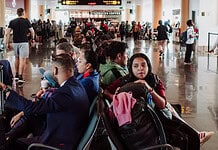






The rail project will only begin phasing in once signalling contracts are awarded – a process CEO Hishaam Emeran says will take 18 to 24 months – following the recent reopening of the central line corridor, which had blocked progress since 2019.
By Larry Claasen
THE Passenger Rail Agency of South Africa (PRASA) says line expansion is one of its top priorities, which includes the creation of the Blue Downs Rail Link, a proposed 9,5km rail connection between the existing Khayelitsha and Bellville-Strand lines.
The proposed link will connect the largest residential areas in the city directly to Bellville, the second-largest and most important work destination in Cape Town.
Currently, commuters travelling between these two nodes by rail must travel via Cape Town to connect between the Khayelitsha and Bellville lines.
PRASA CEO Hishaam Emeran said at the Rail Africa Expo in Sandton in July that the rail company has been stabilised and was now in a position to focus on expanding its rail network.
“We are pretty much at that point. The focus and attention is also switching to expansion. The Blue Downs Rail Link is one of the priority projects we have at PRASA.”
Sorting out its numerous governance issues, ageing equipment and poor maintenance has taken up a lot of Emeran’s time, but now with most of these matters dealt with, he says the group is set up to do a much-needed line expansion.
“In 40 years, when it comes to the commuter rail network, we’ve only built 7km of railway line. That is 4km in Khayelitsha, Cape Town, and 3km in KwaMashu in Durban. That’s all we’ve built.”
A congested city
The creation of the Blue Downs Rail Link connection between Nolungile Station and Kuilsriver Station will go some way to alleviating Cape Town’s traffic congestion. The city’s population grew from 3,74 million to 4,77 million between 2011 and 2022, and was one of the reasons the 2025 INRIX Global Traffic Scorecard showed it rose from ninth to the sixth-worst in congestion among 942 urban areas analysed worldwide.
This growth, along with the closure of the central line rail corridor – which connects Khayelitsha with the city’s CBD and was out of service from November 2019 to February 2026 – compounded the congestion.
Signalling problems
Emeran said PRASA could not go ahead with the Blue Downs Rail Link until the central line rail corridor was reopened. Limited signal capacity in the Western Cape is the other issue holding up the development of the new rail link, but that was being addressed.
“The priorities for PRASA for now are to get the signalling and depot modernised. Once the signalling contracts are awarded for the Western Cape, we’re talking 18 months to two years. And then you can start phasing in the Blue Downs Link,” he said.
Emeran said PRASA was hesitant to develop the link with the existing signalling system, as it would mean it would be offering a limited service on the rail connection.
Improved signalling will allow more trains to run on the railway network at a greater frequency. The current signalling infrastructure caps speeds at 60km/h, despite PRASA’s X’Trapolis Mega train sets being able to reach 120km/h.
The encroachment issue
Aside from improved signalling, the project also has to ensure that the land set aside for the rail corridor has not been encroached upon. This type of encroachment was why the central line rail corridor was closed, as during the pandemic, people built informal housing on the tracks.
“One thing, though, that is key when we talk about new corridors … is the protection of the rail reserve. Because we often see these reserves that are meant for new lines are encroached upon. And that also delays the project … this is something that must be done on a daily and weekly basis,” said Emeran.
The City of Cape Town, in its Integrated Human Settlements Five-Year Sector Plan 2022/23 – 2026/27, also pointed out that setting aside land for the corridor would force thousands of people to find new homes.
“The railway line will cross through various settlements and four informal settlements, namely Khayelitsha, two in Mfuleni, and one north of the proposed Wimbledon Station. Residents of the latter settlements, which number about 5,000 households, need to be relocated prior to the commencement of construction.”
New growth nodes
Despite this, the investment in the rail link will not only facilitate the transport needs of the city’s residents, but could also result in the addition of three stations – Mfuleni, Blue Downs and Wimbledon – which could drive urban development, with these stations acting as growth nodes.
The City of Cape Town, in its Business Plan for the Assignment of Urban Rail report, published in 2017, said the link could support its Transit-Oriented Development (TOD) Strategic Framework. TOD is a spatial planning initiative by the City of Cape Town aimed at integrating previously marginalised communities through reliable transport.