








Electric buses in South Africa gain ground as diesel prices
spike
Diesel’s 54% year-on-year spike to around
R30/litre is strengthening the case for electric buses, but high purchase
prices, charging infrastructure and battery import duties still slow mass
adoption.
Larry Claasen
THE battery powered electric buses (E-Buses) fleet is growing fast but though current higher fuel prices are supporting demand, the high upfront cost per unit compared to diesel counterparts remains a barrier to uptake.
The war in the Middle East has seen the diesel spike by about 54% to around R30/litre in September year-on-year, adding to the cost burden of bus fleet operators. But if they switched to E-Buses, they could reduce energy costs by 33% to 57% compared to diesel, according to the Electrifying Public Transportation report by GreenCape.
GreenCape projects a total fleet of E-Buses to reach 576 by 2030, but research group Marqstats says this figure could rise to as much as 3,200 by 3031.
The appetite for these vehicles are growing as cost saving and their commitment to reduce emissions have already seen several municipalities starting to include E-Buses as part of their commuter fleets.
Municipal fleets and pilots are growing
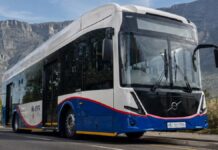
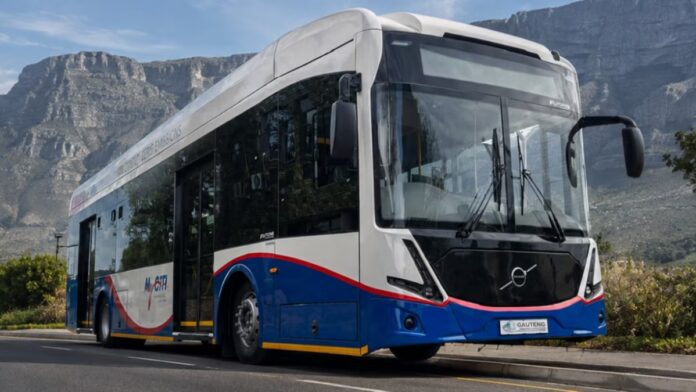
Cape Town based Golden Arrow Bus Services operates 120 BYD vehicles, the city’s MyCiTi services plans to add 38 Volvo BZRLE, and the cities of Tshwane, Johannesburg and eThekwini are either running E-Buses pilots and or plan to run them this year.
Aside from city-operated commuter operators, the University of Johannesburg has deployed 15 vehicles for its Inter-campus shuttle service and the Paruk Group, a private bus/passenger transport group has ordered 100 from MAN Truck & Bus.
The local bus industry is also starting to produce alternatively powered buses. Chinese based SANY, which is better known for making mining and earth moving equipment recently launched its first E-Bus, made in partnership with Busmark, while Gauteng Bus and Coach Centre (GBCC) was selected to build MyCiTi’s Volvo BZRLE buses.
The upfront cost barrier
Though there are considerable savings when it comes to energy usage, the trade off is not a neat calculation. Several costs associated with the switch — like putting in place charging stations, possible solar power facilities, investing in high capacity powerlines and the higher ticket prices for E-Buses — pushes up the cost of conversion.
Moving from diesel to battery power, for example, could see the total cost of ownership — which includes infrastructure costs — only reach breakeven in year 13 after the switch. This is according to the Accelerating a Market Transition in South Africa: Insights into the Bus Industry and Emerging Electric Bus Models report, produced by the C40 Cities.
Breakeven: 13 years or 12–18 months?
Avinash Singh, director of sales and marketing for electric vehicles and hydrogen trucks at Sany Southern Africa, disputes this, saying that the breakeven timeframe is a lot lower.
“We’re now at a point where we can get to a breakeven, in terms of the capital outlay, in something between 12 to 18 months. It basically pays for itself in less than two years including infrastructure, and then you’ve got an EV Bus that’s basically 70% to 80% lower on operating cost.”
The upfront cost of buying an E-Bus, however, compared to a diesel powered one remains a hurdle, as it can cost between double and four times that of a diesel powered one.
Battery localisation: the missing policy piece
The cost of batteries when it comes to powering E-Buses is the primary factor driving up the ticket price. They won’t come down without government policy that favours local content and removes tariff penalties on imported battery cells, says South African Battery Manufacturers Association (SABMA) chairperson Dr. Louis Serfontein.
SABMA is an association of local battery manufacturers formed last year with the goal of advocating for the sector.
The problem when it comes to sourcing batteries locally is that the EV?grade lithium?ion cells needed to power buses are not yet manufactured in South Africa, Serfontein said.
“Automotive?grade battery packs require ISO 26262 functional safety, crash?safety integration, and OEM?specific homologation”
That said, he noted that SABMA members — including Solar MD, Freedom Won, BalanCell, Maxwell & Spark and others — already produce high?voltage, high?reliability lithium packs that are technically adaptable for commercial EV platforms. This has seen several bus operators approach SABMA members for feasibility assessments, integration studies and cost modelling.
What SABMA wants government to do
Despite this interest from operators, Serfontein said the government could support manufacturers by putting in place local content designations in their procurement policies.
Serfontein also suggests that removing the 20% duty on Completely Knocked Down (CKD) imported cells would immediately reduce pack costs by 12% to 18%, making local assembly competitive with imported packs.
He added that Introducing a split?importation framework for EVs and buses, would allow buses to be imported without batteries and fitted locally.
“South Africa can produce world?class EV batteries at competitive prices, create industrial jobs, open export markets, and ensure that our bus and truck operators are supported by local manufacturing OEMs who understand African conditions in design and support. The capability exists; what’s missing is the enabling framework to unlock it,” Serfontein said.